
Introduction to Parallel Database Processing
In Parallel database system, multiple CPUs work in parallel to improve performance through parallel implementation of various operations such as loading data, building indexes and evaluating queries. Parallel processing divides a large task into many smaller tasks and executes the smaller task concurrently on several modes (CPUs). As a result, the larger tasks completes more quickly. These concepts are an important part of the MCA course, helping students understand how modern database systems handle large volumes of data efficiently. Parallel database systems improve processing and input / output (I/O) speeds by using multiple CPUs and disks working in parallel. Parallel databases are especially useful for applications that have to query large database and process large number of transactions per second. In parallel processing, many operations are performed simultaneously, as per opposed to centralized processing, in which serial computation is performed.
Thus, the goal of parallel database systems is usually to ensure that the database system can continue to perform at an acceptable speed, even as the size of database and number of transactions increases. Increasing the capacity of the system by increasing the parallelism provides a smoother path for growth for an enterprise that does replacing a centralized system by a faster machine.
📚 Read Also
Key Elements
The primary key elements of parallel database processing as follows-
- Speed Up
- Scale Up
- Synchronization
- Locking
Speed Up
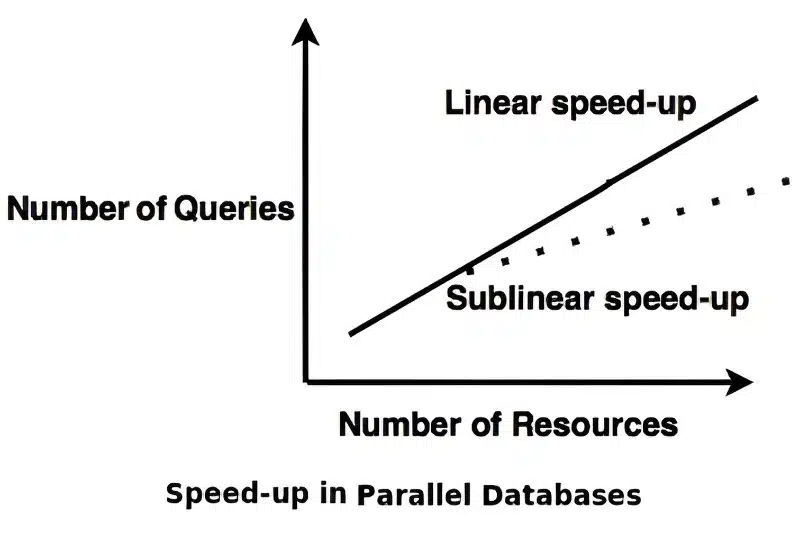
Speed up is a property in which the time taken for performing a task decreases in proportion to the increase in the number of CPUs and disks in parallel. In other words, speed-up is the property of running a given task in less time by increasing the degree of parallelism (more number of hardware).
It is defined as.
Speed = To / Tp
Where
- To = Original processing time
- Tp = Parallel processing Time
Scale-Up
Scale-Up is the property in which the performance of the parallel database is sustained if the number of CPU and disks are increased in proportion to the amount of data. In other words, scale-up is the ability of handling larger tasks by increasing the degree of parallelism in the same time period as the original system. With added hardware a formula for scale up holds the time constant and measures the increased size of task, which can be performed.
It is defined as :
Scale-up = Vp / Vo
Where
- Vp = parallel or large processing volume.
- Vo = original or small processing volume.
Synchronization
It is the coordination of concurrent tasks. For a successful operation of the parallel database systems, the task should be divided such that synchronization requirement is less. it is necessary for correctness. With less synchronization requirement, better speed-up and scale-up can be achieved. The amount of synchronization depends on the number of resources and the number of users and tasks working on the resources. More synchronization is required to coordinate large number of concurrent task and less synchronization is necessary to coordinate small number of concurrent tasks.
Locking
It is a method of synchronizing concurrent tasks. Both internal as well as external locking mechanisms are used for synchronization of tasks that are required by the parallel database system. For external locking, a distributed lock manager (DLM) is used, which is a part of the operating system software. DLM coordinates resource sharing between communication nodes running a parallel server. The DLM allows applications to synchronize access to resources such as data, software and peripheral devices, so that concurrent requests for the same resource are coordinated between applications running on different nodes.
Frequently Asked Questions (FAQs)
Q.1 Explain processing in parallel databases.
Ans: In Parallel database system, multiple CPUs work in parallel to improve performance through parallel implementation of various operations such as loading data, building indexes and evaluating queries.
Q.2 Write key elements of parallel processing.
Ans: Speed Up, Scale Up, Synchronization, Locking.
Q.3 What do you mean by speed-up?
Ans: Scale-Up is the property in which the performance of the parallel database is sustained if the number of CPU and disks are increased in proportion to the amount of data.
Author
Mr.Rahul Agarwal
Associate Professor, Department of CS & IT
Biyani Group Of colleges,Jaipur