
R is widely used for statistical computing, data visualization, and research across a wide range of industries. Learning the fundamentals of R helps students develop analytical thinking, improve their programming skills, and prepare for careers in data science, analytics, and research. For students looking to build a strong foundation in these areas, choosing the Best BCA College can make a significant difference.
Introduction to R Language
R is a programming language specially designed for statistical data analysis and graphical representation. Ross Ihaka, Robert Gentleman and their team developed R at AT & T Bell Laboratories. It derives its name from the fact that R software is used to implement the R programming language. It is extremely flexible and customisable language.
R programming language has a large number of built-in packages, functions, and operators. It is a software package that contains different tools. These tools provide different types of facilities for data manipulation, data calculation, and data storage along with graphics display facilities.
It provides an interactive environment where the user can perform complex mathematical calculations.
The R language graphical tools provide a perfect designing environment that generates publication-ready statistical reports. Researchers can directly use these reports without any additional formatting.
R differs from other Windows-style programs such as Statistical Package for the Social Sciences (SPSS), which use menus with choose-and-click options for predefined statistical processes.
Instead, R has an R console that provides a terminal facility where all the work is completed using command-style text functions.
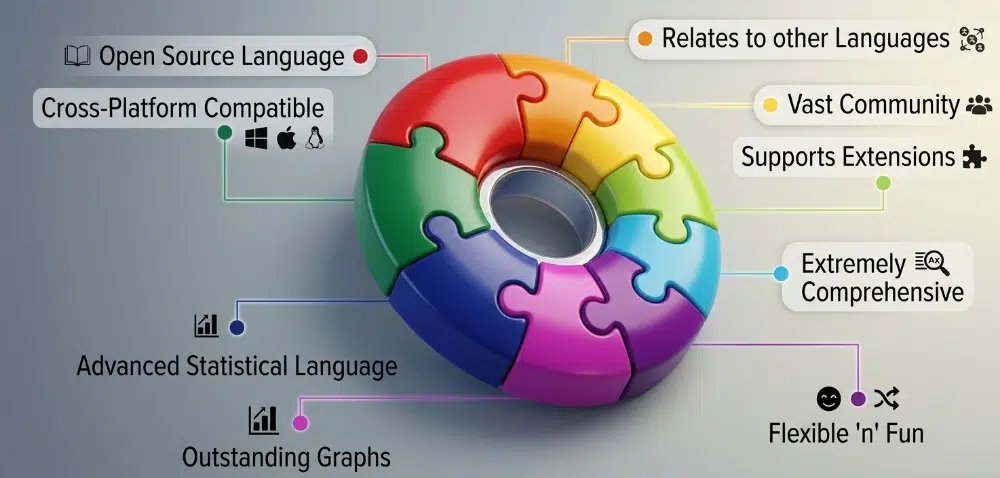
Fig: Features of R Language
Major Parts of R Language Software
The base system and add-on packages are the two major parts of the R language software.
The base system contains the most important package, base, along with other necessary functions.
Some R Language Packages
| Matrix | Boot | rpart | Survival |
| Base | mgcv | class | datasets |
| Graphics | Cluster | MASS | tools |
| Parallel | Codetools | compile | Methods |
Features of R Language
There are many features of the R language. Some are as follows:
- R programming language is open-source, robust, and highly extensible.
- It also permits integration with other procedures written in different languages like C, C++, Python, and .NET.
- There are a large number of built-in packages available in R Programming.
- R is an interpreted programming language, and all commands are directly executed in the console.
- R is a case-sensitive language as most packages are derived from UNIX-based packages.
- R has a large, consistent, and integrated set of tools used for data analysis.
- R contains a suite of operators for different types of calculations on arrays, lists, and vectors.
- R provides highly extensible graphical techniques.
- R supports graphical techniques for data analysis output that can be displayed on a computer or printed on paper.
- R language enables effective data handling and storage facilities.
- R has a vibrant online community.
Applications of R Language
- Weather services use R to forecast severe flooding.
- Social networking companies use R to observe and improve user experience.
- Newspaper companies use R to create infographics and interactive data journalism applications.
- R Programming has become one of the most popular languages for data science and is widely used by finance and analytics-driven organizations such as Google, Facebook, and LinkedIn.
- R Programming is used in statistics, astronomy, chemistry, genomics, business, finance, healthcare, marketing, medicine, and many other fields.
Frequently Asked Questions (FAQs)
Q.1 What is R?
Ans: R is a programming language specially designed for statistical data analysis and graphical representation.
Q.2 Who developed R?
Ans: Ross Ihaka, Robert Gentleman and their team developed R.
Q.3 Write two features of R.
Ans:
1. R is free, open-source, robust, and highly extensible.
2. R has a large, consistent, and integrated set of tools used for data analysis.
Conclusion
R has become one of the most widely used programming languages for statistical computing, data analysis, and visualization across different industries. Students interested in building a career in data science, analytics, and programming should understand its core concepts and practical applications. At Biyani Group of Colleges, students gain the academic foundation and technical exposure needed to develop strong programming and analytical skills for future career growth.
Author
Mr. Rahul Agarwal
Associate Professor, Department of CS & IT
Biyani Group of Colleges