
India is one of the world's biggest consumers of crude oil, consuming roughly 5.4 to 5.7 million barrels per day, according to the Ministry of Petroleum & Natural Gas. Because India relies heavily on imported crude, changes in global oil prices don't stay in the energy market for long. They can affect the rupee, inflation, interest rates, government finances, and, eventually, our everyday expenses. So, how does a change in the price of a barrel of oil end up affecting your pocket?
The Impact of Oil Price Changes:
Oil price changes spread through the economy in several interconnected ways. Here's how a change in global crude prices can travel from international markets to India's economy and eventually to our pockets.
1. India’s Vulnerability to Oil-Price Shocks:
India simply doesn't produce enough oil to meet its needs. In fact, India's crude oil import dependence reached approximately 88% in 2025–26, according to figures shared by the government in the Rajya Sabha.
This high import dependence is the starting point of India's vulnerability to global oil prices. When crude becomes more expensive internationally, India has to pay more for the oil it needs.
This means India needs more US dollars to pay for it, which can put pressure on the rupee.
The source of India's oil imports is also important. Over the past few years, India's crude imports have changed significantly. Russia emerged as India's largest crude supplier, while Iraq, Saudi Arabia, the UAE, the US, and several other countries also remain important sources. India can manage supply disruptions through this diversification, but global oil prices still influence the cost of crude, regardless of its source. So, the vulnerability isn't simply about who supplies India's oil. It is fundamentally about how much India needs to import.
When Global Crude Prices Rise:
Higher crude prices lead to a higher import bill, causing greater demand for dollars, which puts pressure on the rupee, making imports costlier in rupee terms.
And that's where the oil-price story begins to move from the global market into India's economy and eventually into our everyday expenses.
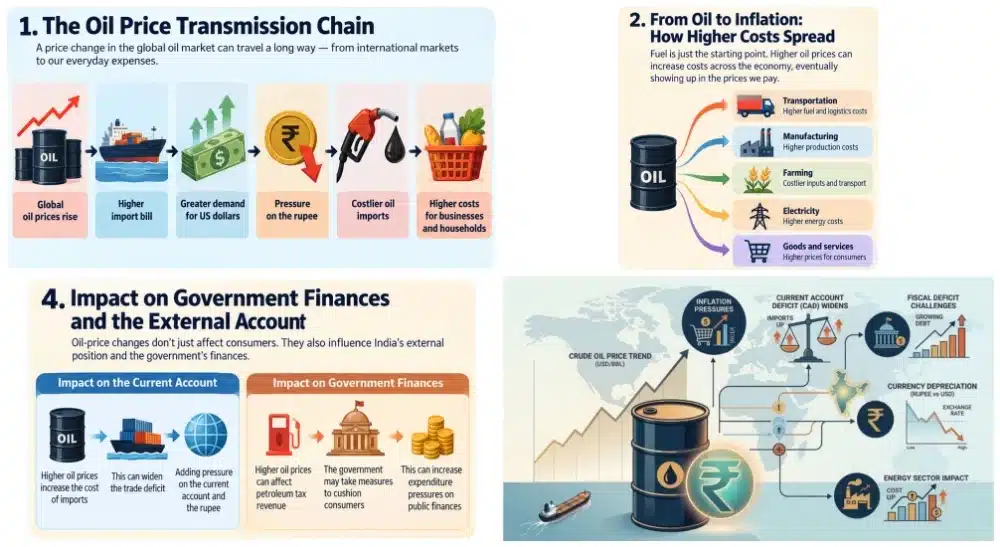
2. How does Expensive Oil Turn into Inflation?
The first and most direct impact of rising crude prices is felt through fuel. According to the data released by the Ministry of Commerce and Industry, India's wholesale fuel and power prices jumped around 22.93% year-on-year in August 2026.
But the impact doesn't stop at the petrol pump. Fuel is used directly or indirectly across transportation, manufacturing, farming, and logistics. When energy and transportation become more expensive, businesses face higher production and operating costs. Businesses may then pass some of these additional costs on to consumers through higher prices. This is known as cost-push inflation.
The numbers also show that inflationary pressure increased during this period: consumer inflation rose from 4.45% in July 2026 to 4.82% in August, while wholesale inflation rose to 9.92%.
But that does not mean oil is the only factor behind inflation. Food prices, weather conditions, global commodity prices, and domestic economic conditions can also influence the overall price level. So, the relationship isn't as simple as “oil goes up, inflation goes up.” Rather, oil prices can add another layer of pressure to an economy that is already being influenced by several factors.
3. Why does the RBI Care About Oil Prices?
This is where the story moves from inflation to interest rates.
The RBI balances price stability with economic growth. So, when inflationary pressures become persistent, the RBI may consider raising interest rates to prevent inflation expectations from becoming rooted in the economy.
As of September 2026, the RBI's key interest rate stands at 5.25%, while the central bank keeps a close eye on inflation, liquidity, and the broader economy.
But here’s the catch: raising interest rates comes with a cost, as higher interest rates make borrowing more expensive for households and businesses. This can reduce spending and investment, which may slow economic activity.
That's why the RBI has to weigh two concerns:
Inflation control ↔ Economic growth
And importantly, an increase in oil prices does not automatically mean that the RBI will raise interest rates. The central bank also has to consider whether the inflationary pressure is temporary or persistent and what is happening across the wider economy.
4. What Happens to India's Current Account?
The impact of expensive oil can also be seen in India's external accounts.
When crude prices rise, India has to spend more on oil imports. If the value of imports increases significantly, it can put pressure on the country's trade balance and, more broadly, its current account.
This matters because India is a major importer of crude oil. So, a sharp rise in global oil prices can increase the amount of foreign exchange needed to pay for imports and add to pressure on the rupee.
In other words, the same oil-price shock that affects the currency can also affect India's external position.
5. What Happens to the Government's Finances?
Oil prices also affect the government's finances. The Indian government collects taxes from petroleum products such as petrol and diesel. At the same time, when fuel prices rise sharply, the government may take measures to reduce the burden on consumers. These measures can affect the revenue it collects from petroleum products.
There can also be an indirect impact. Higher oil prices can increase transportation, logistics, and input costs, which can raise the cost of various goods and services. If the government itself needs to spend more on transportation and measures aimed at cushioning the impact on consumers, this can put additional pressure on public finances.
So, an oil shock isn't simply a problem for consumers. It can also create a balancing act for the government:
Higher oil prices → Higher import costs + pressure on consumers → Possible policy support → Impact on government finances
6. The Wider Impact: From Businesses to Households
The effects of higher oil prices eventually spread far beyond the energy sector.
For businesses, higher fuel and transportation costs can mean higher input costs and lower profit margins. Businesses then have to decide whether to absorb those costs or pass some of them on to consumers.
For households, the impact can show up in more ways than just the price of petrol or diesel. Higher transportation and production costs can feed into the prices of food, goods, and everyday services, putting additional pressure on household budgets.
And this isn't simply a one-time problem. India's dependence on imported crude makes the economy vulnerable whenever global oil prices experience a sharp and sustained movement.
The Way Forward
India cannot control global crude prices. But it can work on reducing how vulnerable it is to them by diversifying energy sources, using energy efficiently, and shifting towards renewable energy. Greater international cooperation can also play a role in improving energy security.
The goal isn't necessarily to eliminate oil from the economy overnight. It is to reduce the extent to which a global oil-price shock can disrupt the domestic economy.
Until that dependence comes down, the chain will continue to matter:
Oil prices → Import bill → Rupee → Inflation → RBI policy → Businesses & households
And that is how a price set in the global oil market can eventually reach your pocket.
Frequently Asked Questions (FAQs)
Q1: What is the impact of an oil-price spike on the rupee?
Answer: When oil prices rise, India needs to spend more on imports. Thus, importers will need to buy more US dollars to pay for their crude oil imports, and that could put upward pressure on demand for the dollar and thus on the rupee.
Q2: How does an oil-price shock propagate into inflation?
Answer: The rise in oil prices could also push up costs in transportation, manufacturing, agriculture, and logistics. Firms may pass some of this additional cost to consumers and so create cost-push inflation.
Q3: What is the role of the Reserve Bank of India in this case?
Answer: If the inflationary pressures persist, then the RBI could respond by raising rates to curb inflation. However, the RBI also considers that higher rates would increase borrowing costs for households and firms.
Q4: What is the impact of rising oil prices on government finances?
Answer: The government collects revenue from taxes levied on petroleum products, so if oil prices rise, the tax collected from petroleum products also increases. But a rise in oil prices would make oil imports expensive for the government.
Q5: How exposed is India to global oil prices?
Answer: India is the third-largest importer of crude oil, which means that India is a significant player in the energy scene, making India more exposed to global oil-price shocks.
Author
Ms. Nidhi Sharma
Student
Biyani Group Of Colleges,Jaipur