
Behavior of Snakes
There are different varieties of snake. As you see any Snake what comes in your mind? Obviously you hit it. But most of the snake in wild life are harmless. Snakes are ectoderms, which means that they can’t regulate their body temperature. Instead, they use their environment, basking in the sun to keep warm or slipping underground to cool off. Snakes prefer to avoid people, and will generally only bite when they are picked up, stepped on, or otherwise provoked. Most of snakes are harmless, several species have defensive displays, like exuding a smelly musk or rattling their tails. These harmless behaviors often cause frightened people to kill the snake. Learn what to do instead. snakes do not carry diseases that are transmissible to humans.
snakes do not carry diseases that are transmissible to humans. 270 species of snakes thrive in India’s tropical monsoon climate, though only 60 of them are venomous. Most of India’s population still lives in rural areas, encounters with snakes are quite frequent.
Here are some tips to recognize difference between poisonous and non-poisonous snakes.Poisonous snake:
- All poisonous snakes are generally brightly coloured
- Venomous snakes have a very distinctive head, looks like hand or triangular and side portion is wide.
- Cobra group of snakes are Highly Venomous
- Venomous snakes has heat sensitive pit
Non poisonous snake:
- Non Poisonous Snakes are not brightly coloured
- Non Poisonous Snake head is usually narrow and elongated
- Usually Nonvenomous snake do not have Fangs but few snakes do have Fangs
- Pythons are Non Venomous but equipped with rows of teeth
Common non Poisonous Snakes in India– Rat snake, Banded kukri, Bronze back tree snake, Sand boa and Indian Python.
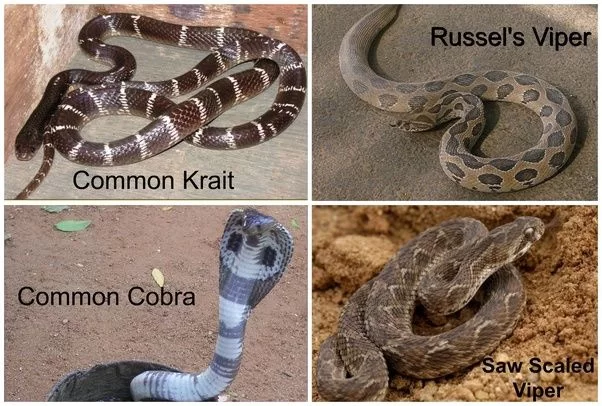
Importance of Snakes in Biodiversity:
Snakes inspire fascination and feelings in a way that no other type of animal can. These long, legless reptiles plays an important role in the natural environment and food webs. Effective hunters and ambush predators, snakes use their highly-developed senses of sight, taste, hearing and touch to locate, recognize and track their prey. Snakes are an important part of our biodiversity. Snakes and other reptiles make up a significant proportion of the middle-order predators that keep our natural ecosystems working. They are play the important part in the food chain. Without them the numbers of prey species would increase in un control manner and the predators that eat snakes struggle to find food. Then natural ecosystem may disturb. You should aware about in this matter and don’t harm the wild life.Frequently Asked Questions (FAQs)
Q.1. How to identify poisonous and nonpoisonous snake?
Ans: Venomous snakes often have a triangular head, specialized fangs, and sometimes vertical pupils, while non-venomous snakes usually show a narrow head, no fangs, and round pupils. Differences in scales and tail shape may also help, but these features are not always reliable. Therefore, it is safest to avoid all snakes and maintain distance, and seek expert help if needed.
Q.2. How to distinguish venomous snakes?
Ans:
- Head: Usually broad and triangular due to venom glands
- Fangs: Presence of long, hollow fangs for venom injection
- Pupils: Often vertical (cat-like)
- Body/Scales: May have rough or irregular scales
- Tail: Generally shorter and thicker
Q.3. Are snakes dangerous to humans?
Ans: Snakes are not usually dangerous to humans, as most species are harmless and avoid contact. However, some snakes produce venom that can cause serious injury if they bite. In most cases, snakes attack only when they feel threatened. Therefore, maintaining distance and not disturbing them helps reduce any risk.
Q.4. What makes a snake venomous?
Ans: Venomous snakes have special glands and fangs that deliver toxin during a bite.
Conclusion
In summary, the ability to differentiate between venomous and non-venomous snakes is important for ensuring human safety as well as supporting wildlife conservation. Although a large number of snakes do not pose a threat, some species carry venom that can be harmful. Observing features such as body structure, scale arrangement, tail form, and the presence of fangs may help in identification, but these signs are not always completely reliable. Therefore, it is advisable to keep a safe distance and avoid handling any snake, particularly when its species is unknown. In uncertain situations, assistance should be sought from trained professionals or local wildlife authorities to handle the situation safely.
Author
Dr. Anisha Sharma
Assistant Professor,Department of Science
Biyani Group Of Colleges,Jaipur