

Configuration and Conformation

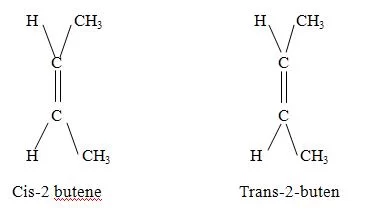
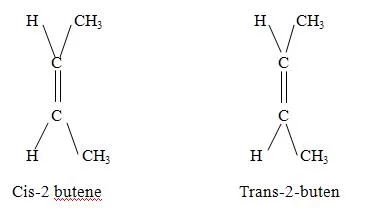
Configuration is saptical arrangement of atoms present in molecules which is stable in general conditions. There is large difference of energies in these configuration. To interconvert one configuration to another bond fission or bond formations is necessary which is not possible in ordinary conditions. They can be isolated with each other. If different configuration obtained due to presence of chiral carbon. Then they are known as optical isomers and these isomers can be differentiated by putting a prefix D and L or R and S

In these two structures the position of H and – OH is opposite. Structure I is not inter convertible tp (II). For this both C-H and C-OH bonds should break and form in opposite positions.

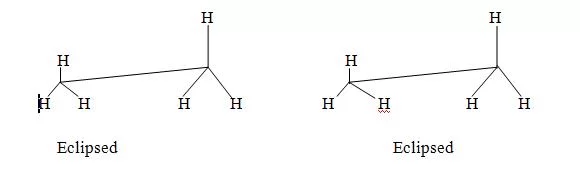
For inter conversion bond fission or bond formation is necessary so they can be isolated. Contrary to this due to free rotation of carbon-carbon single bond different relative positions are formed known as conformations and these relatives structures are known as conformers. Since these different conformers have little energy difference so in general they are inter convertible and they can’t be isolated. For example, ethane have two types of extreme conformations.
(i) Eclipsed conformation
(ii) Staggered conformation

Energy of staggered form is lower than eclipsed form. The different in energy is 28 kcal mol-1.

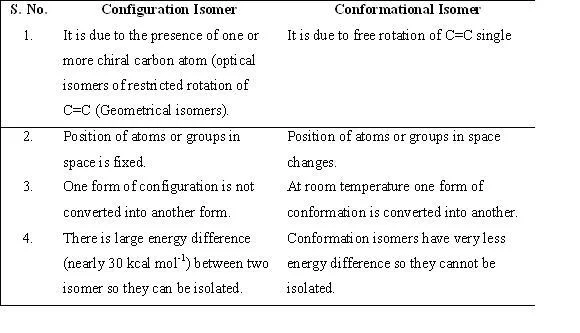
    Table : Difference between configuration and conformations.

The Origins of C++

C++ began as an expanded version of C. The C++ extensions were first invented by Bjarne Stroustrup in 1979 at Bell Laboratories in Murray Hill, New Jersey. He initially called

An Introduction to Pointers

Pointers are variables that hold address of another variable of same data type. Pointers are one of the most distinct and exciting features of C language. It provides power and

User Defined Data Types in C Language

User Defined Data Types in C Language In C programming language we have many user defined data types like structure, union, bit field, enumerator, typedef etc. The most commonly used