
Research or Teaching Not For You?
Chemistry is deeply ingrained in numerous areas of business, government, and environmental management, making an M.Sc. in Chemistry a valuable qualification for professionals seeking specialized knowledge and a competitive career edge. The advanced understanding of chemical principles and analytical techniques gained through the program is highly beneficial in diverse fields such as product development, marketing, management, computer science, technical writing, and even law.
Chemistry in the Modern World
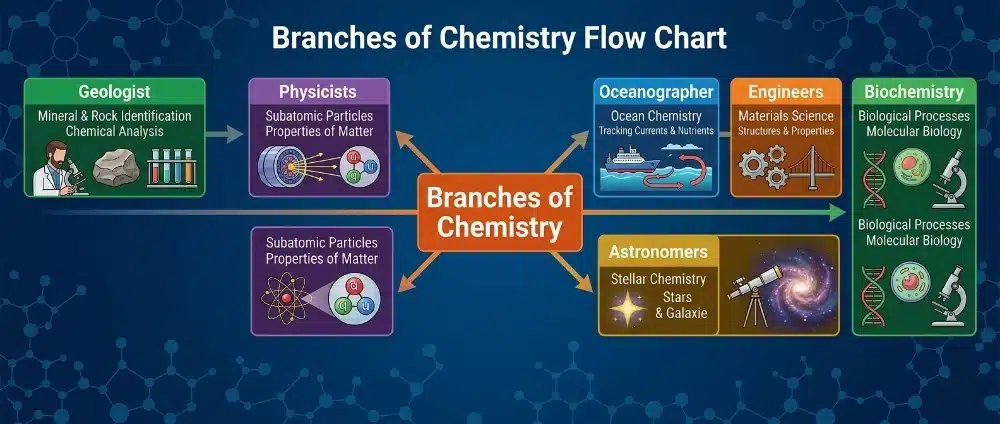
- The study of matter and the changes that material substances undergo.
- extensively connected to other field of study.
Geologist – minerals and rocks identification through chemical techniques
Oceanographer – use chemistry to track ocean currents and nutrients of the sea
Engineers – structures and properties of substances
Physicists – properties of substance to detect new subatomic particles
Astronomers – chemical signatures to determine age and distance of stars
Biochemistry– application of chem to biological process
The Scientific Method
How scientists search for answers; be inquisitive (sometimes attitude?)
Observation → Hypothesis → Experimentation → Conclusion → Model
knowledge can be expanded by chemists through making observations, carrying out experiments, and testing hypotheses to develop laws to summarize their results and theories to explain them. In doing so, the scientific method is used.
A Description of Matter
the structures, physical properties, and chemical properties of material substances are studied by chemists. Matter, which is defined as anything that occupies space and has mass.
Is what the mass of an object describes as the quantity of matter it contains. Mass is different from weight as it is dependent on its location (gravitational force). Mass – lb, Weight – Kg
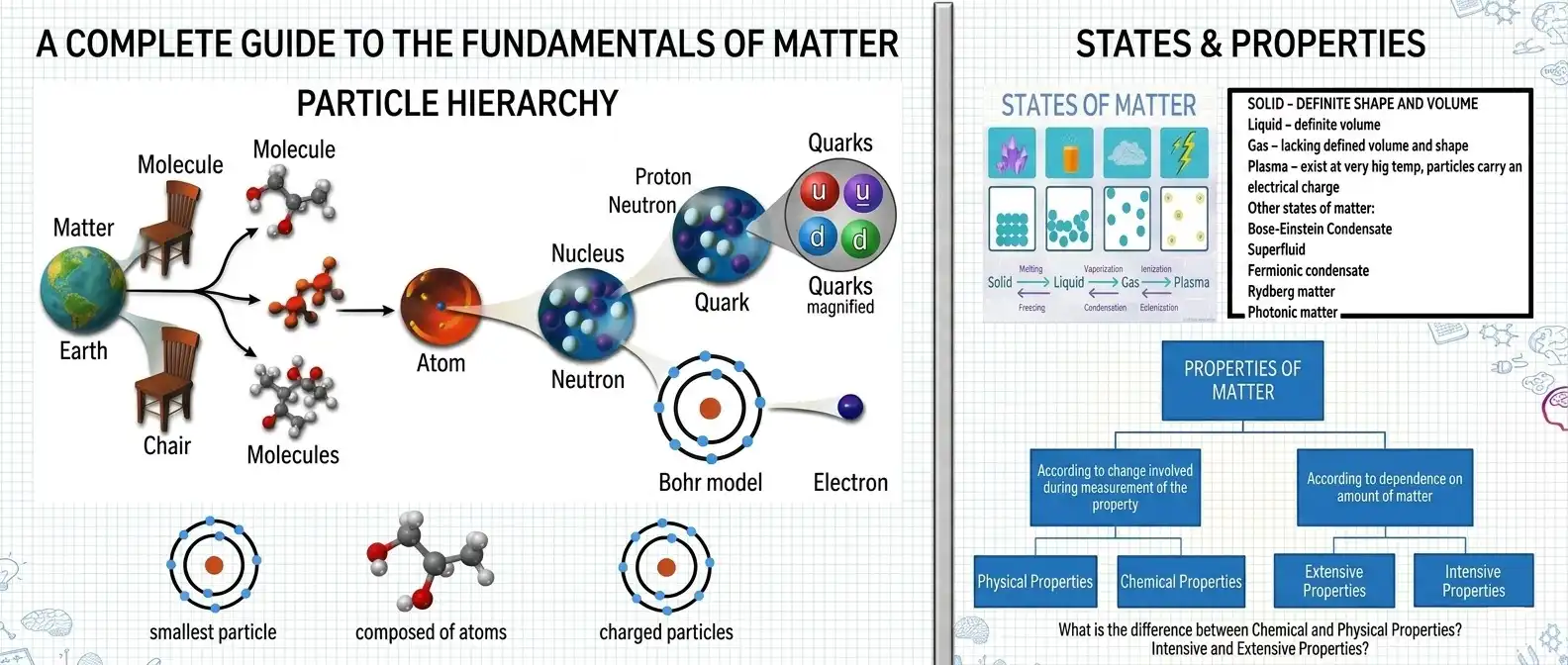
Physical Properties (Extensive or Intensive)
- Characteristics that can be measured w/o changing the composition
- Amount of space occupied by a sample
- Mass, Color, Volume
Chemical Properties
- Ability of substance to react and form new substance
- Flammability and Susceptibility to corrosion
- All pure substance has the same physical and chemical property
(ex. Pure copper is always found to be reddish-brown solid (Px) and always dissolved in dilute HNO₃ to produce a blue solution and a brown gas (Cx))
Example: Pure water has a density of 0.998 g/cm³ at 25 °C.
(Density of water changes with temperature, inversely)
Density = mass / volume
Densities of Common Substances
| Substance | Density at 25 °C (g/cm³) |
|---|---|
| Blood | 1.035 |
| Body fat | 0.918 |
| Whole milk | 1.030 |
| Corn oil | 0.922 |
| Mayonnaise | 0.910 |
| Honey | 1.420 |
Notice that corn oil has lower mass to volume ratio than water. This means that when added to water, corn oil will “float”.
Sample Computations
Imagine you have five bottles containing colourless liquids (label A–E).
You must identify them by measuring the density of each. Using a pipette, you carefully measure 25 mL of each liquid into 5 beakers (known mass = 1 cm³). You then weigh each sample on a lab balance. Based solely on your results, can you unambiguously identify all five liquids?
Solution: Let’s work through the computation and reasoning clearly. You measured 25 mL of each liquid and obtained the following masses:
A: 17.72 g
B: 19.75 g
C: 24.91 g
D: 19.65 g
E: 27.80 g
Final Answer:
Density = mass / volume
All five liquids cannot be unambiguously identified based solely on density measurements While A, C, and E are distinct, B and D have nearly identical densities within experimental error. Additional tests (boiling point, refractive index, chemical reactivity) would be required to distinguish them confidently.
Frequently Asked Questions (FAQs)
Q.1. Why is chemistry considered important even if research or teaching is not pursued by a student?
Answer: Chemistry is found everywhere: it’s not limited to labs or classrooms. An advantage in careers like product development, marketing, management, computer science, technical writing, and even law background in chemistry. It helps students are helped by it to stand out as the team member with specialized space.
Q.2. How does chemistry connect with other fields of study?
Answer: A bridge between the disciplines is acted as by chemistry. For example:
- Minerals and rocks are identified Geologists using chemical techniques.
- Oceanographers track ocean currents and nutrients with chemistry.
- Engineers rely on chemistry to understand materials.
- Physicists detect new particles by studying chemical properties.
- Astronomers read chemical signatures to learn about stars.
- Biochemists apply chemistry to biological processes.
Q.3. What is scientific method and how do chemists use it?
Answer: The scientific method is the way scientists search for answers: Observation → Hypothesis → Experimentation → Conclusion → Model. In chemistry, the scientific method is the systematic process of expanding knowledge. Chemists observe phenomena form and test hypotheses through experimentation, and analyse results. This finding ultimately leads to laws that summarize results and theories that explain them.
Q.4. What’s the difference between physical and chemical properties of matter? the scientific
Answer:
- Physical properties can be measured without the substance (like mass, color, or volume) being changed.
- how a substance reacts to form something new (like flammability or corrosion) is described by its Chemical properties.
For example, Pure copper is always found to be reddish-brown solid (Physical properties) and always dissolved in dilute HNO₃ to produce a blue solution and a brown gas (chemical property).
Q.5. Corn oil float on water, why?
Answer: It’s all about density. Corn oil has a lower mass-to-volume ratio (0.922 g/cm³) compared to water (0.998 g/cm³ at 25 °C). Since it’s less dense, corn oil naturally floats when added to water.
Author
Dr. Neetu Khandelwal
Assistant Professor,Department of Science
Biyani Girls College, Jaipur