
Introduction
Plants have been used for medicinal applications ever since humans began caring for their health and well-being. For centuries, societies around the world have relied on the healing properties of plants. Ayurveda, Siddha, Unani, and Homeopathy continue to depend predominantly on medicinal plants as raw materials for the formulation of traditional medicines. The study of medicinal plants and their therapeutic potential forms an important part of higher education programs such as M.Sc. in Botany, where students explore plant taxonomy, phytochemistry, ethnobotany, and medicinal plant research. The Central Council for Research in Ayurveda and Siddha (CCRAS) has been conducting extensive research on medicinal plants mentioned in classical Ayurvedic texts for the last three decades.
Shatavari means “who possesses a hundred husbands or acceptable to many”. It is considered both a general tonic and a female reproductive tonic. Shatavari may be translated as “100 spouses”, implying its ability to increase fertility and vitality. In Ayurveda, this amazing herb is known as the “Queen of herbs”, because it promotes love and devotion. Shatavari is the main Ayurvedic rejuvenative tonic for the female, as is Withania for the male. Asparagus racemosus (family Asparagaceae) also known by the name Shatavari is one of the well known drugs in Ayurveda, effective treating madhur rasam, madhur vipakam, seet- veeryam, som rogam, chronic fev and internal heat.
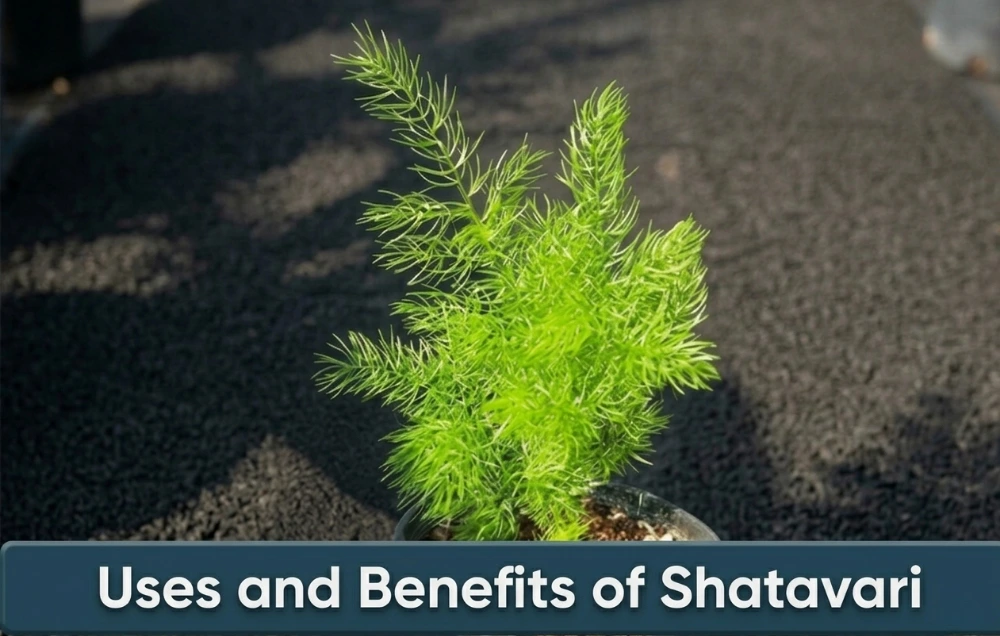
Vernacular name
- Satmuli, Satavari (Sanskrit)
- Satawar, Satavari (Hindi)
- Saatawari, Semukha (Gujarati)
- Indian Asparagus, Hundred Roots, Asparagus roots (English)
Botanical source
- Roots (Rhizomes) and leaves of Asparagus racemosus.
Family: Liliaceae
Morphology
A tuberous climber with straight or hooked spines. The tubers are white, radish shaped, and found in clusters.Short rootstock bearing numerous fusiform tubers. The tubers are bitter in taste. The entire plant has a feathery appearance.The stem is woody and dark green. The branches are modified into leafy structures called cladodes. The flowers are fragrant, small, white, and arranged in clusters. The fruits are pulpy red berries and. have three to six seeds.
Chemical constituent
Shatavari plant contains steroidal saponins, isoflavones, asparagamine (an alkaloid substance similar to aspirin), and polysaccharides. Steroidal saponins are known as shatavarins I–IV. Shatavarin I is the major glycoside containing 3 glucose.Isoflavones include 8-methoxy-5,6,4′-trihydroxyisoflavone 7-O-beta-D-glucopyranoside. Asparagamine is a polycyclic alkaloid.Racemosol is a cyclic hydrocarbon (9,10-dihydrophenanthrene). The plant also contains polysaccharides and mucilage.
Uses
Shatavari roots are used mainly as galactagogue which stimulates the secretion of breast milk.It is applied in improving the lost body weight and also known as an aphrodisiac.The root is useful in disease like, tuberculosis and diabetes.Commonly, it supports to maintain the health by giving immunity to diseases.It is considered as very good energy provider to the weak body system.Root extract is administered to the patients of diarrhea, chronic colic, and dysentery.Boiled leaves of shatavari dipped in clarified butter or ghee are applied to boils and small pox eruptions.Juice of the shatavari bark is mixed with milk and given to women for strengthening their reproductive system and as treatment for gonorrhea.The extract from the roots is boiled with ghee, milk and honey and given for treating seminal weakness and general debility.
Pharmacology
The juice of fresh root of A. racemosus has been shown to have definite curative effect in patients of duodenal ulcers.The root extract of A. racemosus increase milk secretion during lactation. A. racemosus in combination with other herbal is prescribed in Ayurveda to substances in the form of ‘Ricalex’ tablets has been shown to increase milk production in females complaining of deficient milk secretion.Immunomodulating property of A. racemosus has been shown to protect the rat and mice against experimental induced.abdominal sepsis.Alcoholic extract of root of A. racemosus has been reduce the enhanced levels of alanine transaminase, aspartate transaminase and alkaline phosphatase in CC1-induced hepatic damage in rats, indicating antihepatotoxic potential of A. Racemosus.Chloroform/methanol (1:1) extract of fresh root of A. racemosus has been reported to reduce
How Shatavari Helps Women?
Shatavari is considered the best friend of womens health due to the following reasons.Shatavari is capable of curing all problems related to female reproductive systemIt minimizes the complications related to menstrual cyeles including pain, loss of blood and other fluids during menstrual cycle.It balances the female hormonal system.It helps in reducing infertility, leucorrhea, and in regulating ovulation which occurs during the menopause cycle.When combined with Kama Duba, it is a good treatment.
Frequently Asked Questions (FAQs)
1. What is Shatavari?
Shatavari is a plant which is used in the form of Ayurvedic medicine to improve health and strength.
2. What are the uses of Shatavari?
It helps in:
- To Improve digestion
- Helps to the Increase the immunity
- Helps in reducing weakness and stress
- Increases the health of human being
3. Can men use Shatavari?
Yes, men can use Shatavari.
4. How do we take Shatavari?
Shatavari can be taken as powder, capsule, syrup, or tablet with milk or water.
5. Can Shatavari increase immunity?
Yes, it increses inmmunity.
6. Can Shatavari reduce stress?
Yes, it reduce stress and feel relaxed.
Conclusion
Shatavari is an Ayurvedic medicine which helps to increase women’s health as well as men also.. Men and women are using to build better reproductive health. It is also supports to mothers for breastfeeding. Pregnant women should always take Doctor advice before using it . It is mainly uses for strength, energy, and better health.
Shatavari is also helps improving digestion. It may reduce stomach problems such as acidity and weakness.Shatavari supports a healthy digestive system which helps the body absorb nutrients properly .Men and women also use it to increase appetite and improve body strength.
Author
Ms. Pooja Gupta
Assistant Professor,
Department of Science
Biyani Group of Colleges, Jaipur