
INTRODUCTION
For the drinking water of the capital Jaipur, 80 percent water is purified from the Bisalpur Water Supply and the remaining 20 percent water is obtained from the ground through Tube Wells & Handpumps. However, it is worrying that the river is the lifeline of 60% of the people therefore, to get clean drinking water households depend on RO (Reverse Osmosis) purification or Bottled Water. Water is a natural resource, and it supports to keep balance of nature. Both blessings and curses are applied to scientific discoveries.
Scientists developed RO technology to provide pure and clean water, but its misuse is causing a water disaster. Only 0.5% of fresh water on Earth is drinkable, but climate change is threatening that supply. Water scarcity will put a burden on the food supply. Lack of access to clean water is a major health concern in poor nations, where more than 2 billion people live without basic sanitation and millions die each year from water borne infections.
The capacity of RO is measured in litres. For a 4 Member Family, 15 litres of RO is sufficient. But to produce 15 litres of RO treated water, 50 litres of water is used and 35 litres of water gets wasted.
Institutions offering research-driven education, including the Biyani Group of Colleges, encourage students to understand such environmental challenges through modern science and healthcare education. With growing awareness about health, sustainability, and pharmaceutical sciences, students are also looking for the best pharma college options that focus on research, innovation, and social responsibility towards environmental and public health issues.
The Waste Water of RO
So this is the major problem in our lives. Treated water and waste water ratio is approximately 30%-70%. In Jaipur there are around 4.5 lakh houses and almost all have RO systems. To combat this problem, humans should start sustainable water use and focus on waste water management.
The waste water from the RO is used for a variety of different daily tasks such as washing clothing, cleaning kitchenware, cleaning the house, and watering plants and gardens.
1. Water sources in the homes of RO users
EWS, LIG, MIG, and HIG households were chosen as responders, and their information is mentioned below:
- EWS – Economically Weaker Section
- LIG – Low Income Group
- MIG – Middle Income Group
- HIG – Highest Income Group
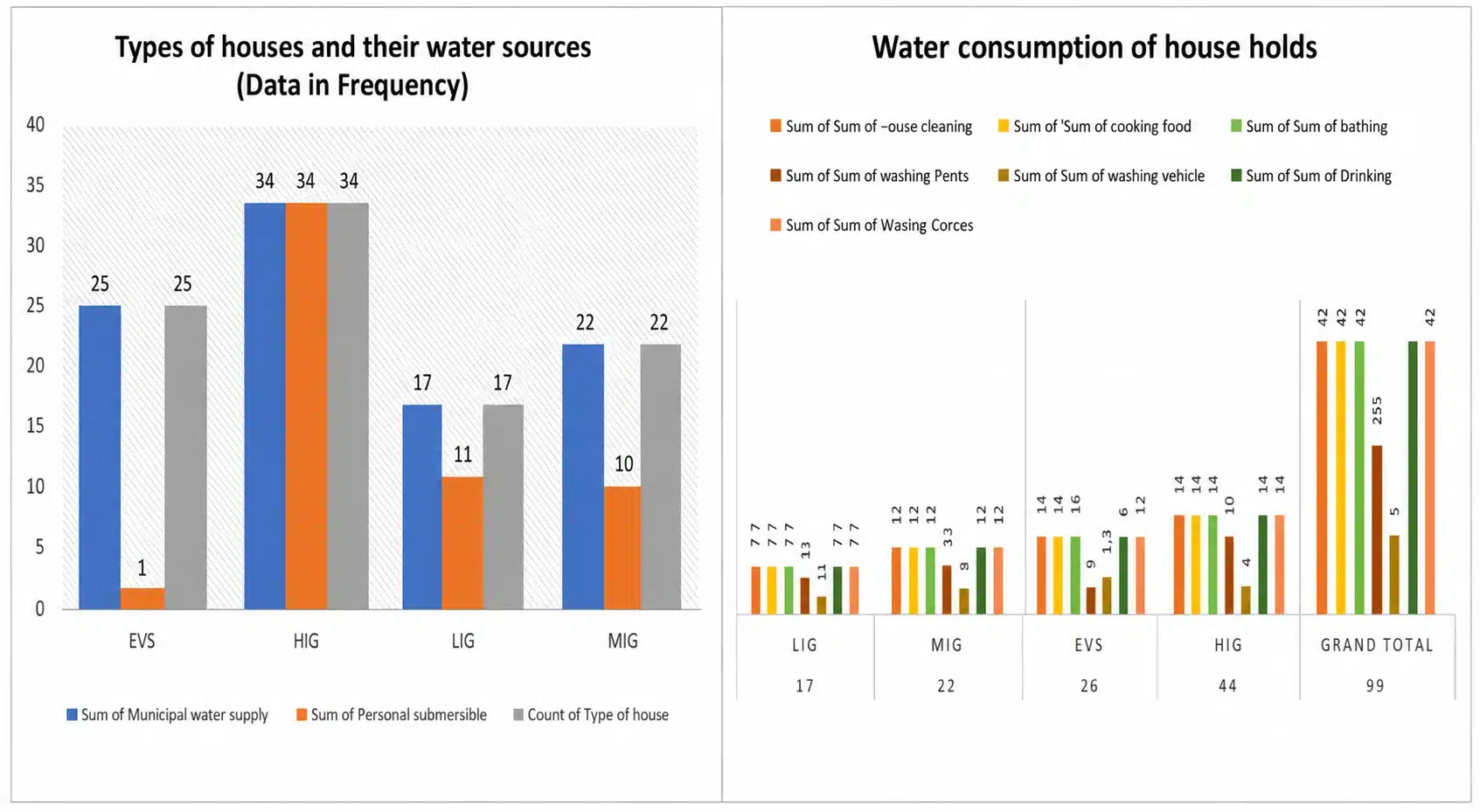
Fig. 1 shows the data in which there are two water sources for water supply in the selected respondents’ homes. Municipal water supply and personal submersible systems are available to all types of residences. HIG, LIG and MIG households also have personal submersibles for water supply, as shown in the above figure.
Both household water consumption and water sources were evaluated in Fig. 2. All types of households use water for drinking, bathing, cooking, washing clothes and sanitation. Apart from this, the requirement of water depends on the income, education, job, etc. of the families.
In economically stronger families, machines are used for gardening, cleaning vehicles, watering trees and washing clothes and utensils, which consumes more water.
The waste water cannot be used for washing because this is hard water, but it can be used in mopping and also to irrigate plants by drip system in which water falls drop by drop near the roots of plants.
It is not necessary that the water is always hard or unusable. RO waste water can also be reused in areas where RO water supply systems are already installed.
2. Solution
In which houses RO waste water is reused?
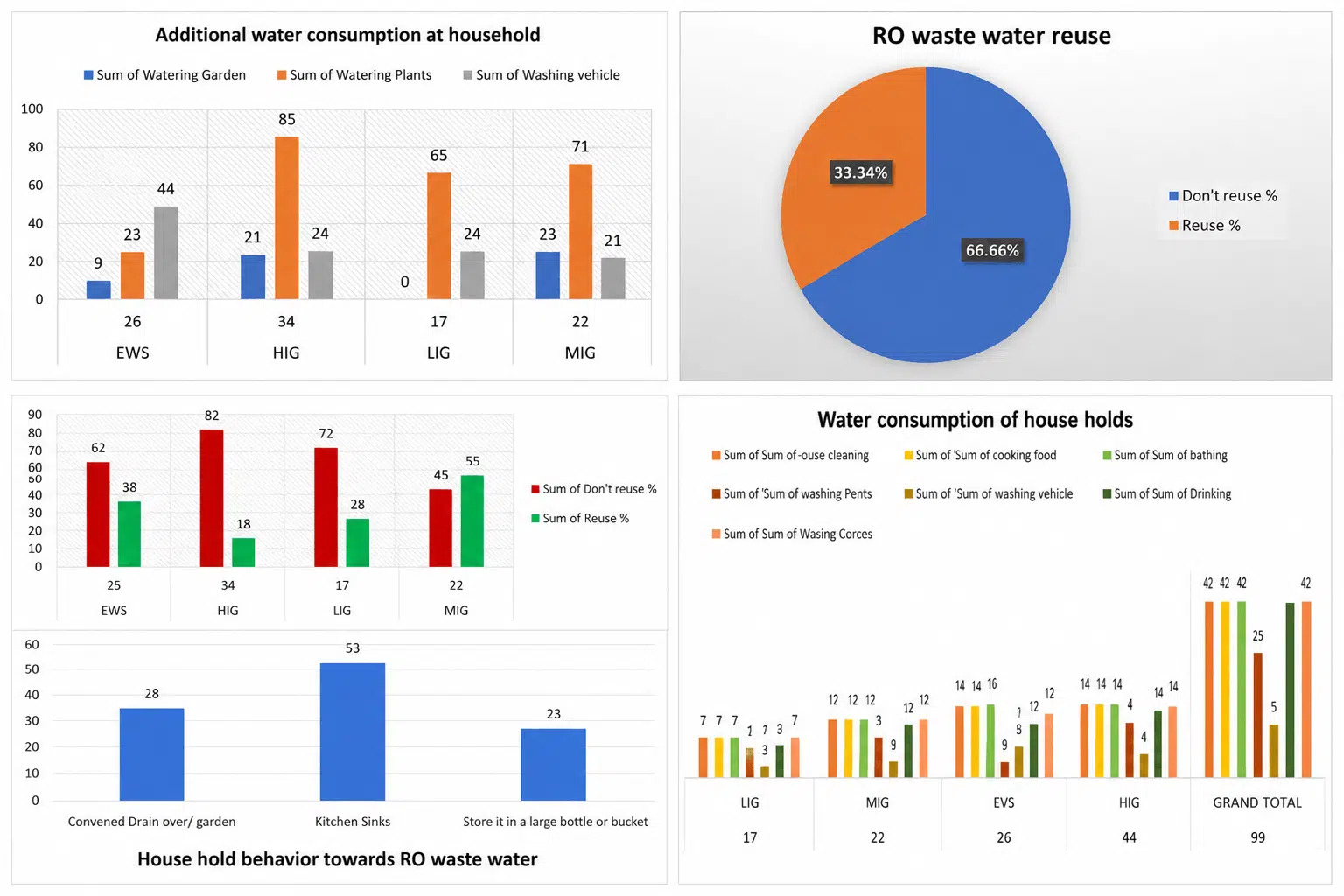
The decision to reuse RO waste water is dependent on the type of house. According to the data shown in Fig. 6, just 38% of EWS households use waste water, while 62% do not.
Similarly, only 29% of LIG households utilize waste water, while 71% do not. Around 55% of MIG houses reuse RO waste water while 45% do not. In HIG houses, 82% do not use RO waste water and only 18% reuse it.
RO waste water can be supplied again to RO systems and then this water can be treated again.
- RO waste water can be collected in a bucket or large bottle and reused.
- RO waste water is mostly used in coolers. This may also be because this research was done during summer time.
- RO waste water is also used for washing clothes.
- After this, the water coming out of RO is used for cleaning vehicles and houses.
- Government should set policies and recommendations to encourage the reuse of wastewater for urban irrigation throughout the country.
- Government should make pipelines to conserve RO waste water. Approximately, in each house 60 litres of RO treated water is produced, but nearly 140 litres of water supply is required to produce RO treated water.
3. Recommendations and Suggestions
- Reusing RO reject water can lead to water conservation, cost savings, reduced environmental impact, and improved overall water management practices.
- It is a sustainable approach that benefits both organizations and the environment by making more efficient use of water resources and reducing the negative consequences associated with reject water disposal.
- Engaging with the local community and demonstrating responsible water management practices, including reuse of reject water, can garner support and goodwill from residents and stakeholders.
- RO manufacturing companies should encourage people to reuse RO rejected water in advertisements. People should be made aware that RO should not be used if it is not necessary.
Frequently Asked Questions (FAQs)
Can I drink or cook with RO waste water?
The reject water contains a high concentration of Total Dissolved Solids (TDS), salts, and impurities rejected
by the RO membrane. Consuming it can lead to health problems.
Is it safe to use for watering plants?
Yes, but with caution. The water is generally safe for domestic gardens, lawns, and potted plants. However, if
your RO waste water has an exceptionally high TDS (over 1000 ppm), or if you notice salt buildup in your
soil, you should dilute it with regular tap water before pouring it on delicate plants.
Can I wash my dishes or clean fruits and vegetables with it?
You can use RO waste water for the initial rinsing or soaking of heavily soiled dishes to loosen dried food. For
fruits and vegetables, you can use low-TDS reject water, but you must always do a final rinse with fresh,
potable water.
Can I use it for bathing, washing clothes, or brushing teeth?
It is not recommended. Because of the high hardness and mineral concentration, reject water can make it
difficult for soap to lather, leave white salt stains, and potentially cause skin irritation or damage delicate
fabrics. It can only be used for the pre-rinsing or soaking of heavily soiled, durable clothing.
What are the best uses for RO reject water?
You can maximize your water conservation by utilizing the reject water for heavy-duty household chores,
including:
- Mopping floors: Requires high volumes of water, and the mineral content won’t affect cleaning.
- Flushing toilets: Divert the reject line into your overhead or toilet flush tank.
- Outdoor cleaning: Ideal for washing cars, rinsing driveways, and cleaning gardening tools.
Conclusion
Water scarcity will put a burden on the food supply, Lack of access to clean water is a major health concern in poor nations, where more than 2 billion people live without basic sanitation and millions die each year from water borne infections. If this water recyclization of Waste RO water is done most of activities related to cleaning, gardening are possible & drinkable water availability is assured to save life of most of nations. Water is nonrenewable resources of our ecosystem on earth. Water is classified as a renewable resource because it is continuously replenished by the Earth’s natural water cycle (evaporation, condensation, and precipitation). However, at a local or regional level, it can act like a non-renewable resource if we consume and pollute it faster than nature can naturally replenish.
Biyani institute of Pharmaceutical sciences, kalwar, Jaipur, Rajasthan work on this future project with our B. Pharma VIII Sem students in field of water purification & waste water recyclization process in Department of Pharmaceutical Chemistry under guidance of Principal & Professor (Dr.) Rambir Singh & co-guide Sushil kumar Agarwal (Professor). A variety of this reuse of RO waste water undergone in different academic institutions. Some private firm also doing this work also.
- RO waste water can be collected in a bucket or large bottle and reuse.
- RO waste water is mostly used in coolers. This may also because this research was done in summer time fig.6.
- In the same sequence, RO waste water is used for washing clothes fig.6.
after this, the water coming out of RO is used for cleaning vehicles, house etc.The
number of which is seen in the picture fig.6. - Government should set policies for recommend to encourage the reuse of wastewater for
urban irrigation throughout the country fig 3. - Government should make pipelines to conserve RO waste water. Approx in each house 60
litres of RO treated water produces but to produce 140 litres of water supply to make RO
treated.
Author
Mr. Sushil Kumar Agarwal
Professor, Department of Pharmacy
Biyani Institute Of Pharmaceutical Sciences