

“There is an old saying that the Constitution is not a mere lawyer’s document, but a vehicle of life.”
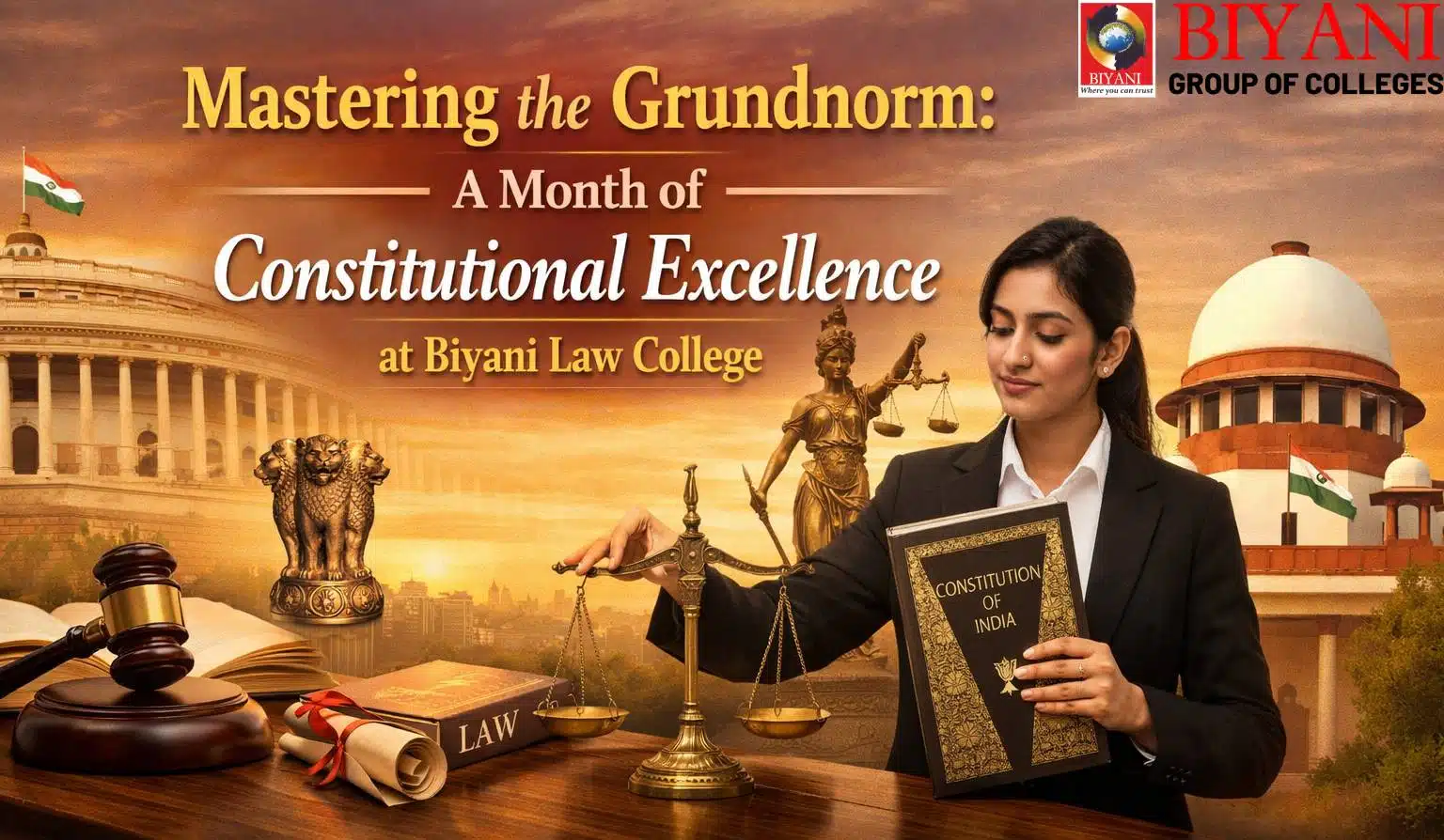
Over the last month, I’ve had the unique privilege of being the “mechanic” for that vehicle. As a teacher at Biyani Law College and the coordinator for these specialized classes, I spent 30 days watching this “Living Document” come to life for our B.A.LL.B. 3rd Semester and LL.B. 1st Semester students.
This initiative, sparked by the vision and constant encouragement of Mr. Abhishek Biyani, was never meant to be just another lecture series. We wanted to bridge the gap between heavy academic doctrine and the aspiring legal minds sitting in our classrooms. To do that, we brought in the energy of Advocate Sanyog Vyas, whose ability to simplify the most complex legal jargon has made him a household name for law students.
Setting a New Benchmark for Legal Academic Events in Jaipur
Jaipur, a long-standing academic center, is successfully evolving to meet the demands of today’s professional world without losing its traditional edge. However, we felt that the traditional classroom model, often bogged down by rote memorization, needed a jolt of energy. The Biyani Law College Constitution Program was designed to be that jolt.
We didn’t want students to just pass an exam; we wanted them to leave the hall thinking, breathing, and arguing like Constitutional lawyers.
Being a premier law college in Jaipur, we recognized that our students—especially those in their early semesters—are at a critical crossroads. They are moving from high school concepts to the rigorous and demanding world of professional critical thinking. This month was about facilitating that evolution.
The atmosphere on campus during this period was electric. It wasn’t just a class; it was a professional transformation. Every morning, as students walked past the library, debates from the previous day’s lecture could be heard. This culture of inquiry was exactly what we aimed to create.
The Genesis: Tracing the Background and Origins
We started at the very roots of our democracy. Advocate Sanyog Vyas didn’t just lecture on the background and origins of the Constitution; he transported students back to the high-stakes atmosphere of the Constituent Assembly.
He painted a vivid picture of 1946–1949, when the future of a new nation was being shaped through deep ideological debates. Students explored the Objectives Resolution and the immense responsibility carried by Dr. B.R. Ambedkar and the Drafting Committee as they reconciled centuries of tradition with a modern vision of justice.
By the time we reached the Preamble, it was no longer just a page to memorize—it became a mission statement. Entire sessions were devoted to understanding the meaning of Justice, Liberty, Equality, and Fraternity, comparing their relevance in 1950 with their significance in 2026.
Even the technical aspects of the Constitution—the Schedules, Part I (The Union), and Part II (Citizenship)—felt urgent and meaningful. Students realized these were not administrative lists but reflections of national identity.
As a coordinator, seeing a first-semester student debate the nuances of Articles 5 to 11 was a moment of pure academic pride.
The Crown Jewel: Part III of the Indian Constitution
The real heart of the program was our deep dive into Part III – Fundamental Rights. Students explored the “Golden Triangle” of Articles 14, 19, and 21, understanding them not merely as provisions but as pillars of liberty.
Landmark cases such as Maneka Gandhi v. Union of India and Kesavananda Bharati were brought to life through storytelling and discussion. These cases transformed from textbook references into powerful moments of constitutional evolution.
Students discovered how Article 21 expanded from protection against physical detention into a broad guarantee covering dignity, privacy, and environmental rights.
The classroom reached its most intense moments during discussions on Constitutional Writs and the Basic Structure Doctrine. The realization that even Parliament cannot alter the soul of the Constitution left a lasting impact on young legal minds.
Balancing the Scales: DPSP and Fundamental Duties
The program then moved toward balancing individual rights with state responsibilities through Part IV (Directive Principles of State Policy) and Part IVA (Fundamental Duties).
Rather than treating these topics as theoretical, students explored them as the moral compass of governance. Discussions revolved around questions such as:
“What is a right without a duty? And what is a government without a goal?”
Debates on the Uniform Civil Code, the Right to Education, and the enforceability of Directive Principles encouraged students to think beyond exams and toward social responsibility.
Students understood that being a lawyer means more than representing clients—it means protecting constitutional values.
The Lasting Impact on Biyani Law College
As a teacher and coordinator, I have witnessed many legal academic events in Jaipur, but the engagement during this program was truly different. Even after sessions ended, the halls of Biyani Law College remained alive with discussion.
Students gathered in the library to read original judgments, formed study groups, and debated doctrines such as the Doctrine of Eclipse and Doctrine of Severability.
The program successfully merged academic rigor with modern teaching methodology, proving that when students receive the right mentorship and environment, learning naturally transforms into excellence.
Reflection from the Co-Coordinator’s Desk
Looking back at the past 30 days, I am amazed by how much ground we covered—from 1940s constitutional theory to modern legal activism.
While my role involved managing logistics, my favorite moments were simply standing at the back of the room and watching a new generation of legal minds find their voice.
Working alongside Mr. Abhishek Biyani, it was deeply rewarding to see our vision of practical legal education take shape. We are not merely producing degree holders; we are nurturing legal thinkers who understand law as a tool for social change.
“The strength of the Constitution lies entirely in the determination of each citizen to defend it.” – Albert Einstein
This month reminded us why legal education matters. Watching students move from hesitant silence in the first week to confident debates by the fourth week was the greatest reward.
The Constitution is now in the hands of our students, and they have moved beyond learning the “what” of law to understanding the “why.”
To the Students of B.A.LL.B. 3rd Sem and LL.B. 1st Sem
Your journey with the Grundnorm has just begun. Keep the flame of inquiry alive!
Author
Mr. Abhishek Sinsinwar
Assistant Professor,Department of Law
Biyani Group Of Colleges,Jaipur