

The interior of the earth can be understood only by indirect evidence as neither any one has nor any one can reach the interior of the earth.
The configuration of the surface of the earth is largely a product of the processes operating in the interior of the earth. Exogenic as well as endogenic processes are constantly shaping the landscape. A proper understanding of the physiographic character of a region remains incomplete if the effects of endogenic processes are ignored. Human life is largely influenced by the physiography of the region. Therefore, it is necessary that one gets acquainted with the forces that influence landscape development. To understand why the earth shakes or how a tsunami wave is generated, it is necessary that we know certain details of the interior of the earth.
It is interesting to know how scientists have gathered information about these layers and what are the characteristics of each of these layers. This is exactly what this chapter deals with. For students enrolled in an MA College in Jaipur, understanding the interior of the Earth is essential for geography coursework and competitive examinations.
Sources of information about the Interior
The earth’s radius is about 6,378 km. No one can reach the centre of the earth and make observations or collect samples of the material. Under such conditions, you may wonder how scientists tell us about the earth’s interior and the type of materials that exist at such depths. Most of our knowledge about the interior of the earth is largely based on estimates and inferences. Yet, a part of the information is obtained through direct observations and analysis of materials.
Direct Sources:The most easily available solid earth material is surface rock or the rocks we get from mining areas. Gold mines in South Africa are as deep as 3-4 km. Going beyond this depth is not possible as it is very hot at this depth. Besides mining, scientists have taken up a number of projects to penetrate deeper depths to explore the conditions in the crustal portions. Scientists world over are working on two major projects such as “Deep Ocean Drilling Project” and “Integrated Ocean Drilling Project”.
The deepest drill at Kola, in the Arctic Ocean, has so far reached a depth of 12 km. This and many deep drilling projects have provided a large volume of information through the analysis of materials collected at different depths.
Volcanic eruption forms another source of obtaining direct information. As and when the molten material (magma) is thrown onto the surface of the earth, during volcanic eruption it becomes available for laboratory analysis. However, it is difficult to ascertain the depth of the source of such magma.
Indirect Sources:Analysis of properties of matter indirectly provides information about the interior. We know through the mining activity that temperature and pressure increase with the increasing distance from the surface towards the interior in deeper depths. Moreover, it is also known that the density of the material also increases with depth. It is possible to find the rate of change of these characteristics.
Knowing the total thickness of the earth, scientists have estimated the values of temperature, pressure and the density of materials at different depths. Another source of information are the meteors that at times reach the earth. However, it may be noted that the material that becomes available for analysis from meteors, is not from the interior of the earth.
The material and the structure observed in the meteors are similar to that of the earth. They are solid bodies developed out of materials same as, or similar to, our planet. Hence, this becomes yet another source of information about the interior of the earth. The other indirect sources include gravitation, magnetic field, and seismic activity.
The gravitation force (g) is not the same at different latitudes on the surface. It is greater near the poles and less at the equator. This is because of the distance from the centre at the equator being greater than that at the poles. The gravity values also differ according to the mass of material.The uneven distribution of mass of material within the earth influences this value. The reading of the gravity at different places is influenced by many other factors. These readings differ from the expected values. Such a difference is called a gravity anomaly.
Gravity anomalies give information about the distribution of mass of the material in the crust of the earth. Magnetic surveys also provide information about the distribution of magnetic materials in the crustal portion, and thus, provide information about the distribution of materials in this part. Seismic activity is one of the most important sources of information about the interior of the earth. Hence, it is discussed in some detail.
Earthquake
The study of seismic waves provides a complete picture of the layered interior. An earthquake in simple words is the shaking of the earth. It is a natural event. It is caused due to release of energy, which generates waves that travel in all directions.
Why does the earth shake?
The release of energy occurs along a fault. A fault is a sharp break in the crustal rocks. Rocks along a fault tend to move in opposite directions. As the overlying rock strata press them, the friction locks them together.
However, their tendency to move apart at some point of time overcomes the friction. As a result, the blocks get deformed and eventually, they slide past one another abruptly. This causes a release of energy, and the energy waves travel in all directions.
The point where the energy is released is called the focus of an earthquake, alternatively, it is called the hypocentre. The energy waves travelling in different directions reach the surface. The point on the surface, nearest to the focus, is called epicentre. It is the first one to experience the waves. It is a point directly above the focus.
Earthquake Waves
All natural earthquakes take place in the lithosphere. The different layers of the earth are learned about later in the chapter. It is sufficient to note here that the lithosphere refers to the portion of depth up to 200 km from the surface of the earth. An instrument called ‘seismograph’ records the waves reaching the surface. A curve of earthquake waves recorded on the seismograph.
Earthquake waves are basically of two types – body waves and surface waves.
Body waves are generated due to the release of energy at the focus and move in all directions travelling through the body of the earth. Hence, the name body waves. The body waves interact with the surface rocks and generate new sets of waves called surface waves. These waves move along the surface.
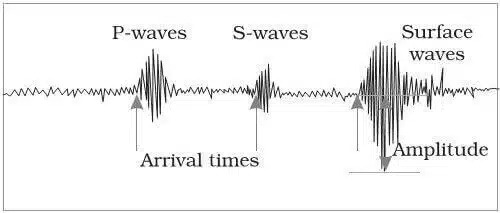
The velocity of waves changes as they travel through materials with different densities. The denser the material, the higher is the velocity. Their direction also changes as they reflect or refract when coming across materials with different densities.
There are two types of body waves. They are called P and S-waves.
P-waves move faster and are the first to arrive at the surface. These are also called ‘primary waves’.
The P-waves are similar to sound waves. They travel through gaseous, liquid and solid materials.
S-waves arrive at the surface with some time lag. These are called secondary waves. An important fact about S-waves is that they can travel only through solid materials.
This characteristic of the S-waves is quite important. It has helped scientists to understand the structure of the interior of the earth.
Reflection causes waves to rebound whereas refraction makes waves move in different directions. The variations in the direction of waves are inferred with the help of their record on seismographs.
The surface waves are the last to report on seismographs. These waves are more destructive. They cause displacement of rocks, and hence, the collapse of structures occurs.
Propagation of Earthquake Waves
Different types of earthquake waves travel in different manners. As they move or propagate, they cause vibration in the body of the rocks through which they pass. P-waves vibrate parallel to the direction of the wave. This exerts pressure on the material in the direction of the propagation. As a result, it creates density differences in the material leading to stretching and squeezing of the material.
The other three waves vibrate perpendicular to the direction of propagation. The direction of vibrations of S-waves is perpendicular to the wave direction in the vertical plane. Hence, they create troughs and crests in the material through which they pass. Surface waves are considered to be the most damaging waves.
Emergence of Shadow Zone
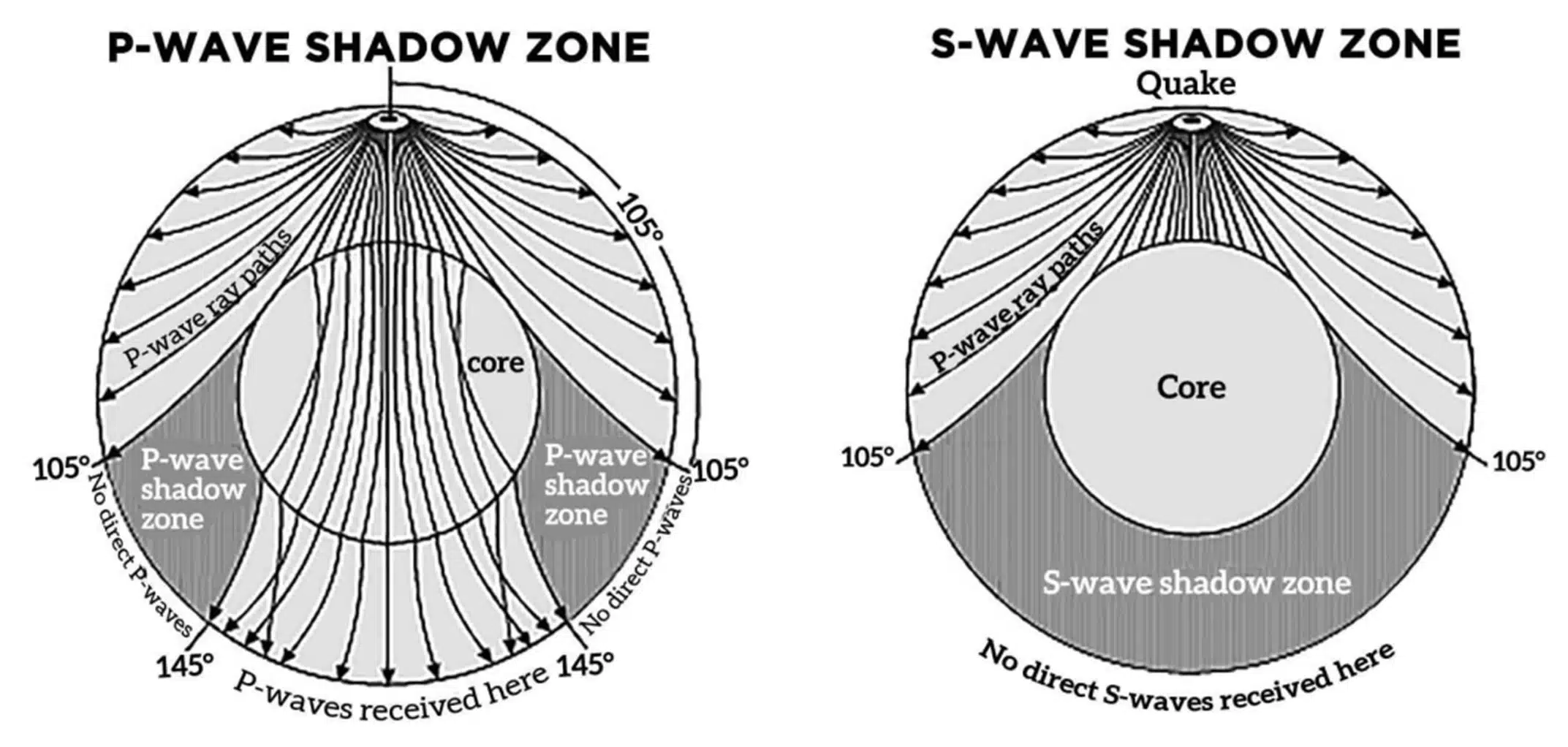
Earthquake waves get recorded in seismographs located at far off locations. However, there exist some specific areas where the waves are not reported. Such a zone is called the ‘shadow zone’. The study of different events reveals that for each earthquake, there exists an altogether different shadow zone.
It was observed that seismographs located at any distance within 105° from the epicentre, recorded the arrival of both P and S-waves. However, the seismographs located beyond 145° from the epicenter, record the arrival of P-waves, but not that of S-waves.
Thus, a zone between 105° and 145° from the epicenter was identified as the shadow zone for both the types of waves. The entire zone beyond 105° does not receive S-waves. The shadow zone of the S-wave is much larger than that of the P-waves.
The shadow zone of P-waves appears as a band around the earth between 105° and 145° away from the epicentre. The shadow zone of S-waves is not only larger in extent but it is also a little over 40 per cent of the earth surface.
Types of Earthquakes
- The most common ones are the tectonic earthquakes. These are generated due to sliding of rocks along a fault plane.
- A special class of tectonic earthquake is sometimes recognised as volcanic earthquake. However, these are confined to areas of active volcanoes.
- In the areas of intense mining activity, sometimes the roofs of underground mines collapse causing minor tremors. These are called collapse earthquakes.
- Ground shaking may also occur due to the explosion of chemical or nuclear devices. Such tremors are called explosion earthquakes.
- The earthquakes that occur in the areas of large reservoirs are referred to as reservoir induced earthquakes.
Measuring Earthquakes
The earthquake events are scaled either according to the magnitude or intensity of the shock. The magnitude scale is known as the Richter scale. The magnitude relates to the energy released during the quake. The intensity scale is named after Mercalli, an Italian seismologist.Effects of Earthquake
- Ground Shaking
- Differential ground settlement
- Land and mud slides
- Soil liquefaction
- Ground lurching
- Avalanches
- Ground displacement
- Floods from dam and levee failures
- Fires
- Structural collapse
- Falling objects
- Tsunami
Structure Of the Earth
The Crust: It is the outermost solid part of the earth. It is brittle in nature.
The Mantle: The portion of the interior beyond the crust is called the mantle.
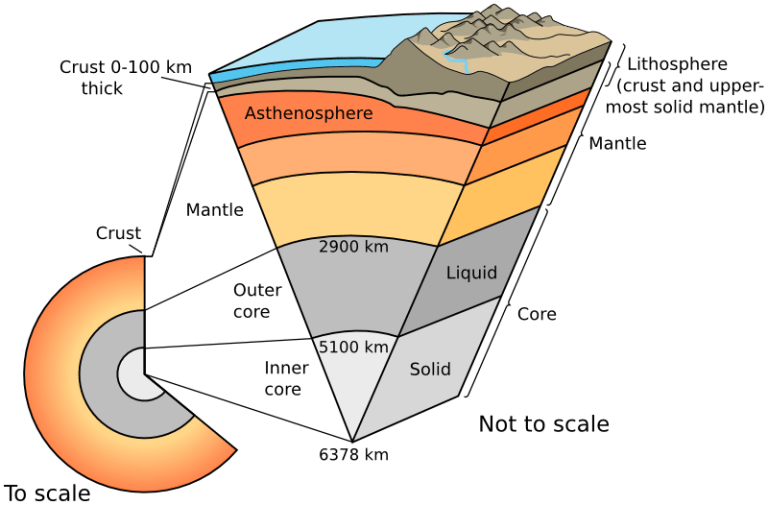 The Core:
The core is made up of very heavy material mostly constituted by nickel and iron.
The Core:
The core is made up of very heavy material mostly constituted by nickel and iron.
Blog By: Ms.Sarika Gupta
Assistant Professor,Department of Social Science
Biyani Group Of Colleges