
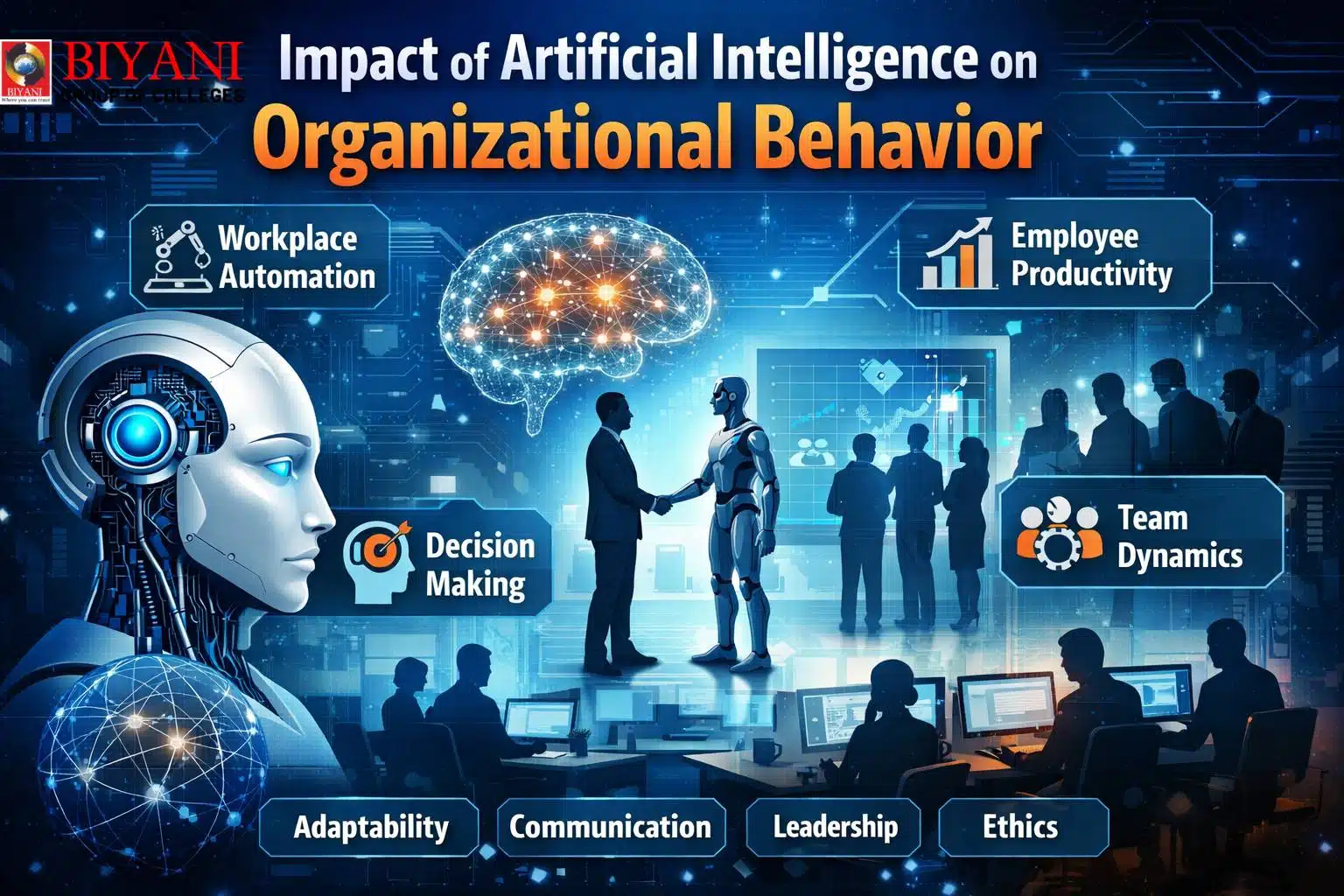
Artificial Intelligence (AI) is revolutionizing organizational operations because it creates new operational systems which affect how staff members perform their duties. Organizational Behavior (OB) studies how people in organizations develop their attitudes while they work on team projects and follow leadership directives. The implementation of AI systems across office spaces, manufacturing facilities, and service operations has resulted in multiple effects which impact the human elements that exist within organizational structures.
Change in Employee Behavior and Attitude
AI systems perform automated operations which handle basic data entry work and scheduling functions. These systems reduce employee workload so staff members can dedicate their time to specialized and innovative activities. However, the development of job loss anxiety among employees can lead to negative workplace attitudes and decreased self-assurance.
Organizations need to train their staff members to use AI systems effectively because these tools function better when people understand their operation instead of fearing them.
Effect on Motivation and Performance
AI systems provide fast feedback and measure performance accurately. The system delivers specific feedback which motivates workers because they can monitor their results and achievements in real time. However, AI systems used for continuous monitoring may create work-related stress, leading to employee dissatisfaction.
Managers must ensure that AI is used to support employees rather than control them.
Influence on Leadership and Decision Making
Leaders increasingly depend on AI-based data for decisions related to promotion, training, and productivity. These systems can promote unbiased leadership because decisions are based on logical and data-driven methods. However, leaders must continue to demonstrate empathy and emotional understanding, as machines cannot interpret human emotions effectively.
Impact on Teamwork and Communication
AI tools enable smooth communication through virtual meetings, project management software, and chatbot systems. These technologies improve collaboration by connecting employees working from different locations. However, reduced face-to-face interaction may weaken personal relationships and teamwork effectiveness.
Employees need a balance between digital communication and direct human interaction to maintain overall well-being.
Change in Organizational Culture
The implementation of AI technology encourages organizational cultures that promote innovation, continuous learning, and efficient resource utilization. Employees must regularly upgrade their skills to adapt to technological advancements.
Organizations that rely entirely on automated systems without human oversight risk losing personal connections among employees. Therefore, human values such as trust, fairness, and cooperation must remain protected.
Ethical and Psychological Impact
AI systems raise ethical concerns related to employee data protection and fairness in performance evaluation. Continuous digital monitoring can increase employee stress levels. Organizations must establish clear policies and maintain transparency while using AI to ensure ethical practices and positive organizational behavior.
Conclusion
Artificial Intelligence technology directly affects organizational operations by influencing employee behavior, leadership practices, teamwork, and organizational values. AI systems improve efficiency and decision-making but require human oversight for responsible implementation.
Organizations that successfully combine technological advancement with human values will create workplaces that support employee well-being and foster positive organizational environments.
Author
Ms. Mumal Singh
Assistant Professor, Department of Commerce
Biyani Group Of Colleges, Jaipur