

Wouldn’t it be great if rectifying a genetic disorder was as easy as fixing a writing error? Doesn’t it sound unbelievable? This is exactly what CRISPR is attempting to achieve.
Using a genetic modification technique called CRISPR, researchers can alter the DNA of living cells. To put it simply, it functions like microscopic molecular scissors. It can cut a particular piece of DNA and replace, repair, or eliminate it — even in human DNA.
What if medical professionals could treat hereditary illnesses before they even become harmful? What if we could genuinely fix the issue in human DNA rather than merely treating symptoms? Although this concept may sound like science fiction, CRISPR technology is turning it into reality.
CRISPR is a gene-editing technology that allows scientists to precisely modify DNA. It works like extremely accurate scissors that cut a specific DNA sequence and replace it with a corrected version, repair it, or remove it entirely.
How Does CRISPR Operate?
CRISPR was discovered during experiments on microorganisms. Scientists observed that bacteria could protect themselves against viruses. During an attack, bacteria store a tiny portion of the virus’s genetic material. When the same virus attacks again, the bacteria recognize it and use a protein called Cas9 to destroy it.
Researchers later adapted this natural defense system to edit genes in living organisms. Emmanuelle Charpentier and Jennifer Doudna were awarded the Nobel Prize in Chemistry in 2020 for developing this revolutionary technique.
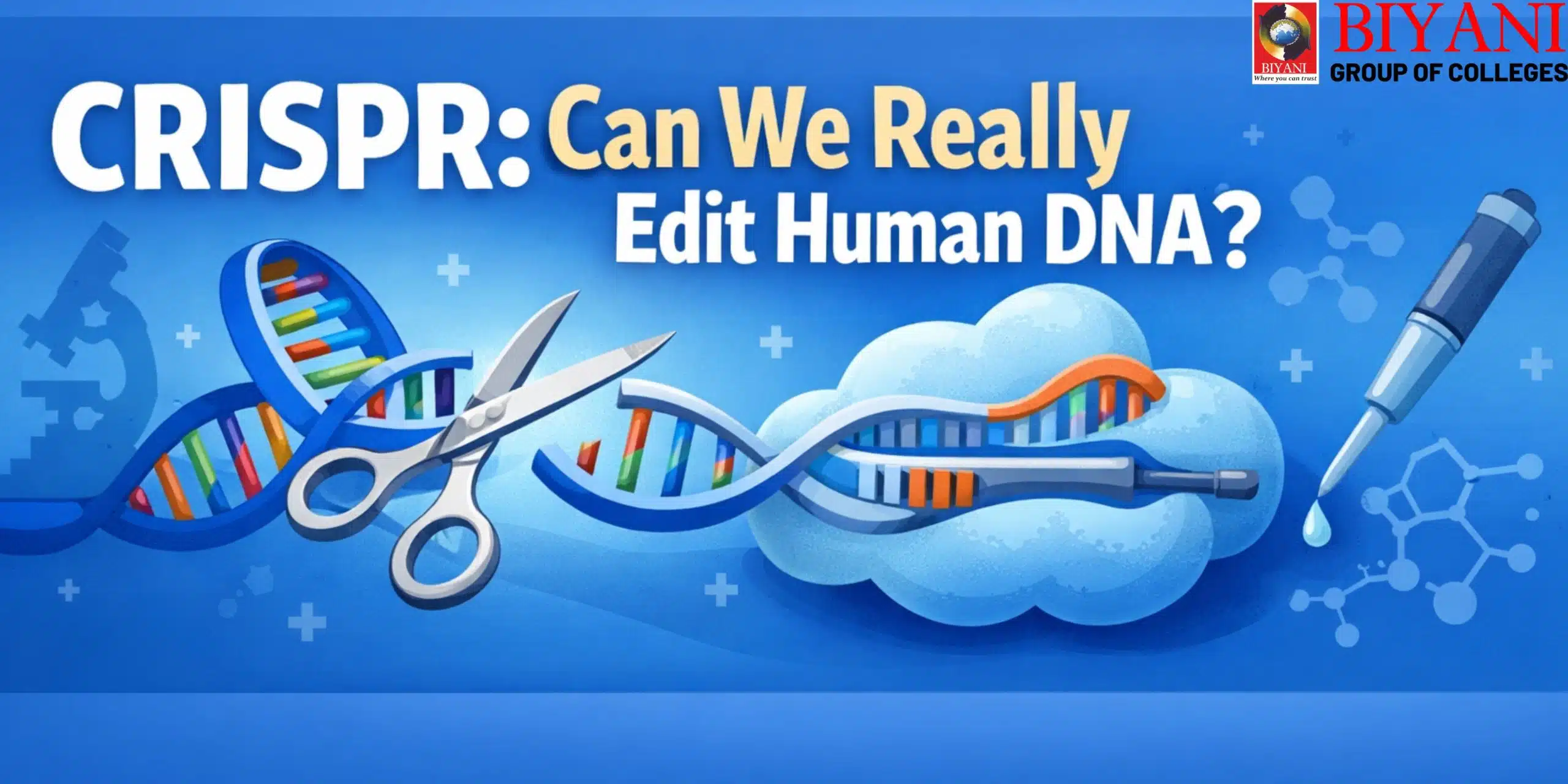
CRISPR Working Steps
- A guide RNA identifies the exact DNA sequence that needs to be changed.
- The Cas9 protein cuts the DNA at that precise location.
- The cell repairs the cut, during which the DNA can be modified or corrected.
Compared to earlier genetic modification techniques, CRISPR is faster, cheaper, and more accurate.
Applications of CRISPR
- Genetic Disorder Treatment
CRISPR is being used in research and clinical trials to treat inherited diseases such as sickle cell anemia and other blood disorders. Instead of treating symptoms, scientists aim to correct the root genetic cause.
- Cancer Research
Scientists are modifying immune cells to better identify and attack cancer cells, opening new possibilities for advanced cancer therapies.
- Agriculture
CRISPR helps improve crop quality, enhance disease resistance, and protect crops from environmental stress.
- Scientific Research
In medicine and biotechnology, CRISPR helps researchers better understand gene functions and develop new treatments.
- Could people choose physical traits like height or eye color?
- Should humans be allowed to design specific characteristics?
Moral Controversy
Despite its benefits, CRISPR also raises ethical concerns. In 2018, a Chinese scientist announced the birth of genetically modified babies, causing worldwide controversy. This process, known as germline editing, allows genetic changes to be inherited by future generations.
Most scientists support using CRISPR to treat life-threatening diseases. However, ethical questions arise when it is used for enhancement rather than treatment.
These questions show that gene editing is not only a scientific issue but also involves ethics, law, and social responsibility.
Conclusion
CRISPR is one of the most significant scientific discoveries of recent years. It offers hope for improving healthcare and treating hereditary diseases while also challenging us to define the limits of science.
Editing human DNA carries immense potential. If used responsibly, it can improve lives and reduce suffering. However, careless use may create serious ethical and social challenges.
Frequently Asked Questions (FAQs)
1. What is the full form of CRISPR?
Ans: Clustered Regularly Interspaced Short Palindromic Repeats.
2. How does CRISPR work?
The Cas9 enzyme acts like molecular scissors to create a double-strand break in DNA, guided by RNA to a specific DNA sequence.
3. What are its primary uses?
It is used in scientific research, agriculture, environmental studies, and potential therapies for diseases such as sickle cell anemia.
4. Is CRISPR risky?
There are some risks, including off-target effects and possible unintended DNA damage, so careful regulation is required.
5. What are the ethical issues of CRISPR?
Ethical concerns include editing human embryos, inherited genetic changes, and unintended mutations affecting future generations.
Author:
Ms. Khushboo Choudhary
Assistant Professor, Department of Science
Biyani Girls College, Jaipur