
Family- Poaceae (Grass Family)
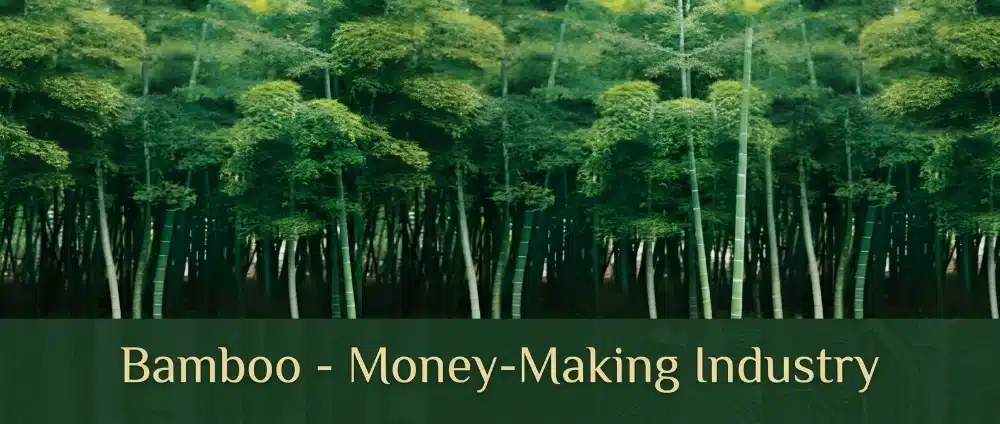
Bamboo is a Versatile, strong renewable and environment friendly plant It has a lot of Economic Benefits and that is why it is a huge business to start a bamboo Farm. Because of its strength and resilience, bamboos are utilized as a building material (scaffolding, roofing, flooring et al) in the construction industry, A bamboo farm once started could continue to exist for years on and give you some form of residual income. Bamboo starter plants, meanwhile, are sold from $25 to more than $100.Bamboo is an important non wood forest product. In India, bamboo, which traditionally considered the Poor man wood, and labelled as Green Gold is being considered a major export item by the centre for the global market.
Bamboo is perfectly suited to agro forestry as a woody grass. Bamboo has been exploited from natural stands from time immemorial. Bamboo is increasingly being cultivated like other agricultural crops, that is, in professionally managed plantations. The growth of industries utilizing bamboo requires the sustainable cultivation and management of bamboo resources. India is blessed with very rich bamboo resources. This is where students pursuing M.Sc. in Botany gain practical knowledge about plant science, biodiversity, forest ecology, sustainable agriculture, and environmental conservation, helping them contribute to research and sustainable bamboo cultivation practices.
India is blessed with very rich bamboo resources. Bamboo can play an important role in raising forest cover and a major role in stabilization of the environmental problems. The annual yield in tonnes/ha depends on the environment as well as the species. It is estimated that almost 25% of the biomass in the tropics and 20% in the subtropics, come from bamboo. The cultivation of bamboo as a wood substitute helps to offset depletion of the rain forest. Its rapid growth ensures an effective reconstruction of damaged eco systems. Bamboo is one of many sustainable non wood resources that can generate income for a large forest dependent rural population and it needs to take further steps to realize its full potential.
Botanical Description of the Plant
Bamboos are typically fast-growing perennials, with some species growing as much as 30 cm (1 foot) per day. The woody ringed stems, known as culms, are typically hollow between the rings (nodes) and grow in branching clusters from a thick rhizome (underground stem). Bamboo culms can attain heights ranging from 10 to 15 cm (about 4 to 6 inches) in the smallest species to more than 40 metres (about 130 feet) in the largest. While the narrow leaves on young culms usually arise directly from the stem rings, mature culms often sprout horizontal leaf- bearing branches. Most bamboos flower and produce seeds only after 12–120 years’ growth, and then only once in their lifetime; reproduction is largely vegetative. Some species spread aggressively and can form a dense undergrowth that excludes other plants.
Global Status of Bamboo Industry
- The world bamboo market is estimated to be > $ 7 Billion/yr. as of 2007 and is estimated to increase to $ 20 Billion/yr. till 2017.
- The global bamboo trade volumes are estimated to be between USD 5.0 billion and USD 10 billion (FAO, 2005).
- It is hypothesised that, the market for bamboo processed products can replace wood to majority of purposes.
- It has been estimated that the total market size of bamboo flooring materials will rise to Rs. 19500 million by 2015 (NABARD).
- India’s bamboo economy is expected to grow by over 15% to touch Rs. 260,000 million by 2015.
Potential Areas of Increased Demand of Bamboo
- Bamboo shoots
- Furniture and value added products
- Bamboo plastic composites
- Bamboo panel; plywood, particle board, hard board, medium density fiber board (MDEB) oriented stand board, wood polymer, Bamboo mat, Bamboo cement panel
- Bamboo houses including earthquake resistant houses; structural and building construction material.
Why Bamboo?
- Sustainability – Fast growing
- Short rotation – Harvestable from 3 yr. onwards
- Adaptability – Different agro climatic conditions
- Economical – Easily available at cheaper cost.
- Environmental friendly – Carbon sequestration, land reclamation, water harvesting, reduces soil degradation, etc.
- Plantation – Large scale plantations can be brought up easily.
- Uses – > 1500 documented uses.
- Social acceptance – Liked by the society from the old costumed baskets to furnished bamboo flooring
- SOAKING: A method commonly used in India is to soak bamboo for ninety days in water. Then set to dry in a sunny area for two weeks.
- AIR DRYING: Cut the bamboo leaving the branches and leafs still attached. Store the bamboo upright in the sun for two weeks. Then continue drying in a cool dry place out of direct sunlight, cross your fingers and hope for the best. Depending on the area, watch for molding.
- ABURANUKI: The Japanese method of drying used by the Shaku hachi or flute makers of Japan.
Uses of Bamboo
- Pulp, paper and rayon (major industrial uses)
- Agriculture & Handicrafts: Bamboo baskets, stacking material, agriculture implements and structural material.
- Bamboo houses, disaster resistant bamboo buildings, walling, roofing and structural material
- Sericulture, Fisheries, Medicinal
- Bamboo seeds and shoots used as food and leaf as fodder
- Panels as substitute of traditional timber spp, Plywood, Particle Board, Hard board, Medium Density Fiber board
- Other importance uses: Carbon sequestration, checking soil erosion, water conservation, wind barrier, bio-fencing, restoration of degraded land, important social forestry and agroforestry species
- The jointed stems of bamboo have perhaps the most numerous uses; the largest stems supply planks for houses and rafts, while both large and small stems are lashed together to form the scaffoldings used on building-construction sites. The stems are also split up to make buckets and pipes or are used to make furniture, flooring, walking sticks, fishing poles, garden stakes, and other utensils. Some species of bamboo are used as ornamentals in landscape gardens. The fine-grained silica produced in the joints of bamboo stems has been used as a medicine in the Orient for centuries under the name tabasheer. East Asian artists, poets, and epicures have long celebrated the beauty and utility of bamboo in paintings and verse.
- Release 30% more oxygen in atmosphere & absorbs more carbon dioxide compares to other plants.
- To use in Asian cuisine served as salad consumed in the form of soup.
- Various animals on the planet used bamboo in their diet.
- Panda’s diet is based on bamboo exclusively.
Frequently Asked Questions (FAQs)
1. What is the scientific name and family of bamboo?
The scientific name of bamboo discussed here is Bambusa
vulgaris, and it belongs to the Poaceae (Grass) family.
2. Why is bamboo called “Green Gold”?
Bamboo is called “Green Gold” because of its high economic
value, wide industrial uses, rapid growth, and increasing
importance in global trade and export markets.
3. What are the major uses of bamboo?
Bamboo is used in construction, furniture making, paper and pulp
industries, handicrafts, flooring, food products, medicinal
purposes, agriculture, and eco-friendly building materials.
4. Why is bamboo considered environmentally friendly?
Bamboo grows rapidly, absorbs more carbon dioxide, releases
more oxygen, helps in soil conservation, water harvesting, land
restoration, and reduces environmental degradation.
5. What are the common methods used for drying bamboo?
Common methods of drying bamboo include soaking, air drying,
and the Japanese drying technique known as Aburanuki.
Author:
Ms. Monika Saini
Assistant Professor, Department of Science
Biyani group of Colleges , Jaipur