
Introduction
In B2C e-commerce, businesses sell directly a diverse group of products and services to customers. Main pure B2C e-commerce big companies or platforms are as Amazon.com, and hepsiburada.com other traditional businesses have entered the virtual marketplace by establishing comprehensive web sites and virtual storefronts. In these cases, e-commerce is substitute of the traditional or retail commerce by providing goods, products, data, services etc through electronic channels. Some of the advantages of these e-commerce sites and companies include availability of physical space (customers can physically visit the store), availability of returns (customers can return a purchased item to the physical store), and availability of customer service in these physical stores. Understanding these B2C e-commerce concepts is especially important for students pursuing computer application programs, as e-commerce technologies, online business systems, and digital platforms are key areas of study in a top mca college in jaipur, helping students build practical knowledge of modern digital business environments.
A Business-to-Consumer E-Commerce Cycle
The E-Commerce cycle contain 5 major phases involved in conducting B2C e-commerce. The B2B e-commerce model uses a similar cycle, as shown below:
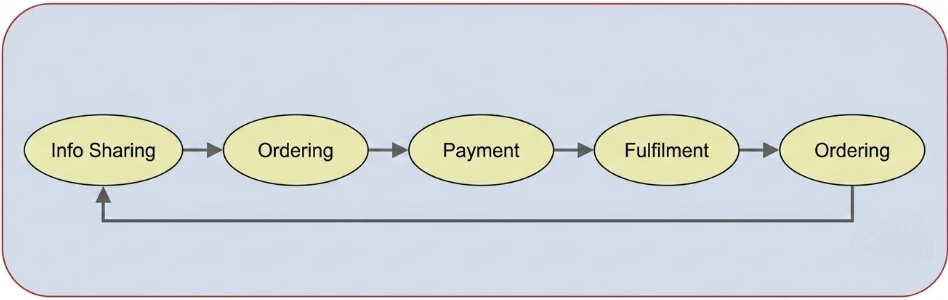
- Info sharing: A B2C e-commerce may use some or all of the following applications and technologies to share information with customers: Online advertisements, e-mail, newsgroups/discussion groups, company web site, online catalogs, message board systems, bulletin board systems, multiparty conferencing.
- Ordering: A consumer may use e-mail or Google forms available on the Buyer’s web site to order a product/good/service from a B2C site.
- Payment: Credit cards, electronic checks, and digital cash are among the popular options that the customer has as options for paying for the goods or services.
- Fulfillment: Fulfillment or commitment is key responsible for physically timely delivering the product or goods or service from the merchant to the customer. Timely delivery at preferred time and date by preferred payment method is helpful and desired.
- Service and support: B 2 C E-Commerce is an economic and cost saving option to maintain current customers than to attract new customers. For this reason, e-businesses should do whatever that they can in order to provide timely, high-quality service and support to their customers. As e-commerce companies lack a traditional physical presence and need other ways to maintain current customers, service and support are even more important in e-commerce than traditional businesses. The following are some examples of technologies and applications used for providing service and support: (E-mail confirmation, periodic news flash, and online surveys may also be used as marketing tools.)
- E-mail confirmation: In major situations, the e-mail confirmation provides the customer with a confirmation number that the customer can use to trace the product or service. E-mail confirmation promises the customer that a particular order has been processed and that the customer should receive the product/ service by a certain date.
- Periodic news flash: They used to give customers with the latest information on the company or on a particular product or offering.
- Online Surveys: Their results can assist the e-commerce site to provide better services and support to its customers based on what has been collected in the survey, even though online surveys are mostly used as a marketing tool.
- Help desks: They provide answers to common problems or provide advice for using products or services. They are used for the same purpose as in traditional businesses.
- Assured secure transactions & assured online auctions: They guarantee customers that the e-commerce site covers all the security and privacy issues. As many customers still do not feel comfortable conducting online business, the security and privacy services are especially important.
📚 Read Also
Types of B2C Companies
B2C companies divide into five major categories: direct sellers, online intermediaries, advertising-based models, community-based models and fee-based models. Each type is so different from the others that they are not directly comparable. In fact, some B2C businesses utilize more than one type to reach different audiences.
a) Direct Sellers: Direct sellers, such as online retailers, sell a product or service directly to the customer via a website. You can further divide direct sellers into e-retailers and manufacturers. E-retailers are electronic retailers that either ship products from their own warehouses or trigger deliveries from other companies and stocks. Product manufacturers use the Internet as a catalog and sales channel to eliminate intermediaries.
b) Online Intermediaries: Online intermediaries perform the same function as any other broker. The business allows non-B2C companies to reap some of the benefits. Brokers offer buyers a service and help sellers by altering the price-setting processes.
c) Advertising-Based Models: Popular websites rely on advertising-based models. These websites offer a free service to consumers and use advertising revenue to cover costs. They draw a large number of visitors, making them ideal advertising streams for other companies. Advertisers will pay a premium to sites that deliver high traffic numbers.
d) Community-Based Models: Community-based models combine the advertising method that relies on traffic at sites that focus on specialized groups to create communities. Community sales and advertising take advantage of social and network marketing by focusing on specific groups that want specific products. For example, sites used by computer programmers are perfectly placed to advertise computer hardware and software products. At least one social media website uses member information to target advertisements to interests and locations.
e) Fee-Based Models: Pay-as-you-buy or paid subscription services fall under fee-based models. The most common of these are online subscriptions to journals or movie sites such as Netflix. These companies rely on the quality of their content to convince consumers to pay a usually nominal fee.
Frequently Asked Questions (FAQs)
Q.1 What is B2C E-Commerce?
Ans: In B2C e-commerce, businesses sell directly a diverse group of products and services to customers.
Q.2 Write two types of B2C Companies.
Ans: Direct Sellers, Online Intermediaries
Q.3 What are the payment options?
Ans: Credit cards, electronic checks, and digital cash are among the popular options that the customer has as options for paying for the goods or services.
Author
Mr. Rahul Agarwal
Associate Professor,Department of CS & IT
Biyani Group Of Colleges,Jaipur