
The modern world is highly independent and what happens in one country affects others. As one of the world’s largest and fast-developing economies, India is faced with global conflict, shifts in trade relations, energy prices, and geopolitical competition. At the same time, the geopolitical & trade pressures give India a chance to become more competitive.
Geopolitical Tensions
India has strong connections with major players of the geopolitical arena such as USA, Russia, China, and the EU. However, balancing the interests of different countries in such geopolitical environment is quite challenging.
One of the most challenging relationships of India is with China as it is the largest geopolitical competitor of India. Being one of the two major economic powers & trading partners, India and China have been experiencing tensions because of border issues. Therefore, India pays more attention to developing infrastructure of the borders, its defense, and reducing excessive dependence on Chinese products.
India maintains strong relations with the USA and other countries using grouping like the Quad. Additionally, it keeps good relations with Russia, especially in the field of defense and energy. Thus, building relations with several major players while protecting the interests.
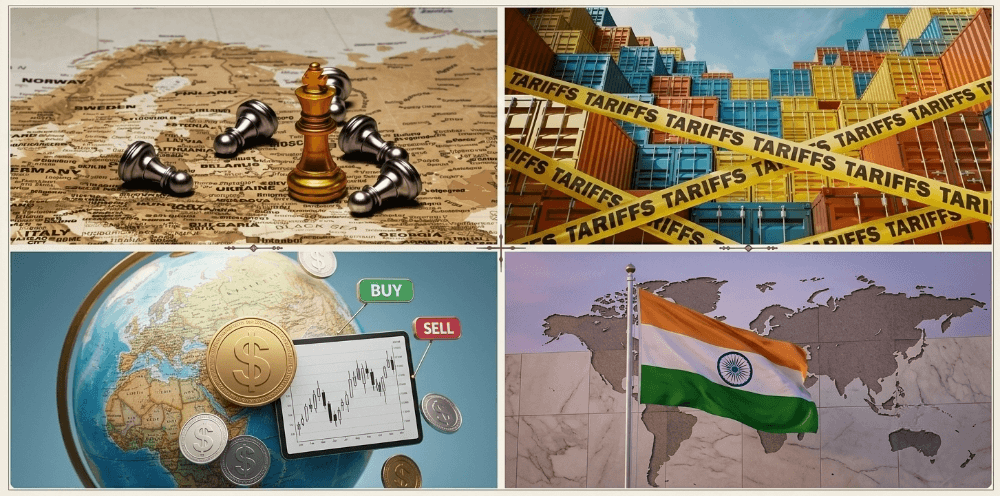
Impact Of World Conflicts
Wars and conflicts around the globe can affect India even if it is not a direct participant in the conflict. The most prominent impact is on the price of energy. A majority of crude oil imported into India comes from other countries, and hence, any problem in the countries where the oil is produced can result in higher international oil prices.
Higher oil prices can raise the cost of transporting and manufacturing goods. It can raise prices of basic necessities, causing inflation, and increasing India’s import bills. Conflicts can also hamper the international trade routes.
If any international shipping route becomes dangerous due to the conflicts, then the ships might be forced to adopt alternate and costlier routes for their travel.
📚 Read Also
Rapidly Changing Global Trade Dynamics
The global trade scene is rapidly evolving. Many nations are increasingly seeking ways to diversify their supplier base and develop safer and more diversified supply chain networks. This presents a golden opportunity for India – foreign companies interested in locating their manufacturing operations in a new destination will consider India due to its huge domestic market and skilled manpower. The ‘Make in India’ and other production – linked incentive programs target increasing domestic production and exports.
But India faces stiff competition from other countries like China, Vietnam and other manufacturing nations.
Tariffs And Other Trade Restrictions
Tariffs and other forms of trade barriers also form an important issue. Tariffs might be imposed by countries for protecting their own industries or in the case of any trade dispute between nations. While tariffs may benefit certain industries, it may make imported materials and parts more costly.
Any change in trade policies of key market nations will influence Indian industries such as textiles, pharmaceuticals, automobiles, electronics, and engineering. Thus, Indian exporters need to stay competitive while adjusting themselves to changes in international trade laws. Trade agreements may be helpful in making it easier for India to enter foreign markets. However, this could expose India to increased competition from foreign companies operating in India.
Energy Security
Energy security is linked with geopolitics. Due to its high dependency on imported crude oil and natural gas, the fluctuations in global energy market will affect the economy greatly.
India is striving to minimize its dependency on foreign sources of energy through expansion of its use of renewable energy & diversity of its energy supplies. Solar and wind energy gain importance.
Clean energy industry provides for opportunities. India has an opportunity to build its industries in such areas as solar energy, batteries, electric cars and green hydrogen. However, development of these industries is associated with investment, modern technology and minerals.
Technology And Critical Minerals
Nowadays, technology became an integral element of global competition. Modern economy requires semiconductors, artificial intelligence, telecommunications equipment and batteries. India strives to develop its domestic capabilities in such spheres as semiconductors production and electronics. Decreasing dependency on foreign technologies will enhance economic and national security of India.
However, many modern industries depend on such critical elements as minerals and modern technology available only in several countries.
Opportunities Of India
Nevertheless, geopolitical & trade pressures have potential for creating many opportunities. If companies wish to diversify their supply chains, they might invest in India, which will result in job creation, increased exports and innovations.
The consumer base of India and its convenient geographical position make India a good choice for foreign businesses. Moreover, strong trade relationships with various countries might facilitate entry of Indian companies into new markets.
India can take advantage of its diplomatic relations to enhance economic cooperation without jeopardizing strategic independence of India.
The Way Forward
To address geopolitical and trade pressures, India requires a balanced approach to the problem. It is important for India to diversify its sources of energy and export markets in order to avoid overreliance on any single country. Improvements in infrastructure and education are necessary to strengthen competitiveness of Indian businesses. In addition, India should keep developing renewable energy and technology.
Finally, diplomacy will continue playing an important role for India. Positive relationships with different countries will protect India from geopolitical and trade pressures.
Conclusion
Increasing geopolitical issues and trade issues are becoming increasingly relevant for the economic development of India. Conflicts around the world, energy prices, tariffs, supply chain disruptions, and technology competition may affect the Indian economy.
But such factors can be viewed as both threats and opportunities. Using the fluctuations of the global trade situation, India can attract investments, improve production, export goods and create new technologies.
The effectiveness of these efforts will be determined by the ability of India to balance its national interests and cooperate with other countries.
Author
Ms. Sarika Gupta
Assistant professor,Department of Social Science
Biyani Group Of Colleges,Jaipur