
Introduction
Any substance that has an impact on the human or animal body, such as curing an illness, reducing pain, altering mood, feeling, or behaviour, is called as drug. It could be as simple as the aspirin that we take for a headache or as complex as a targeted therapy for cancer. But, how are these life-saving drugs discovered by scientists? Historically, discovering a novel drug has been an incredibly long, expensive, and uncertain journey. Scientists first understand the disease, then search for a “target” (such as a faulty protein), design possible molecules (by screening thousands of chemical compounds), perform in-vivo and invitro studies () in labs and animals, carrying out several stages of human trials, and eventually receiving regulatory permission, which usually takes ten to fifteen years and costs billions of dollars to get a single novel medication from the lab onto the shelf of our neighbourhood pharmacy. Drug research is one of the riskiest scientific ventures because many promising candidates fail along the road.
For students interested in understanding this fascinating process and building a successful career in pharmaceutical sciences, choosing the best pharmacy college in Jaipur can provide the right academic foundation, practical exposure, and research opportunities in modern drug discovery and development.
What Role does Artificial Intelligence (AI) Play in the Process of Finding New Drugs?
Artificial intelligence (AI) is a technology that is rapidly transforming this landscape. AI is the ability of computer systems to carry out tasks that often require human intelligence, such as problem-solving, pattern recognition, learning from data, and generating predictions. AI acts as a highly advanced research assistant in the field of drug discovery. It can analyse large biological and chemical datasets in a matter of minutes, predict how a molecule will respond in the body, predict side effects or toxicity of molecules before they are tested in humans, reduce safety risks, design new compounds with desired properties, match existing drugs to new diseases (drug repurposing), speed up the availability of treatments, and even predict the success of clinical trial. AI is making it possible for scientists to work faster, smarter, and more cost-effectively than ever before.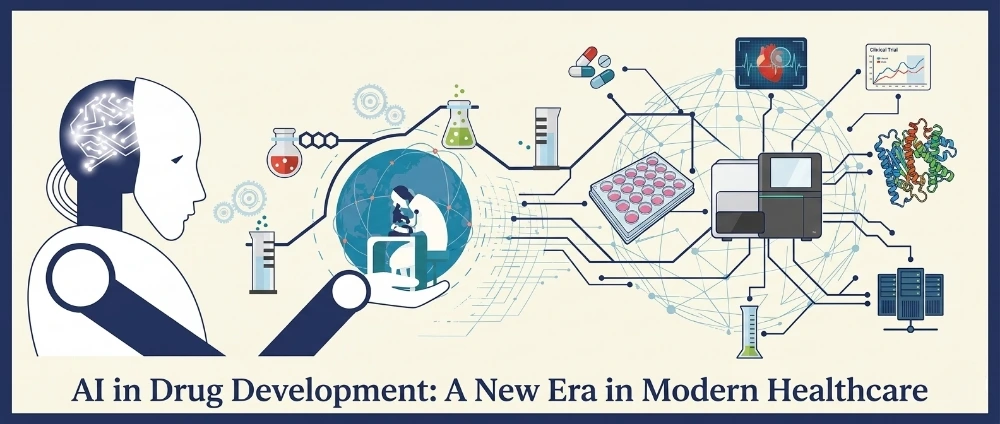
AI in Drug Discovery in Everyday Situations
1. Treatment of Diabetes with Personalised Medicine: AI algorithms look at genetic profiles, lifestyle information, and blood sugar patterns to identify which diabetes drug will work best for a patient. Instead, then using a one-size-fits-all approach, doctors can now prescribe metformin, insulin, or other drugs based on AI- driven forecasts of individual response and side-effect risk. Better blood sugar control and less trial-and-error medications will benefit millions of patients globally.
2. Faster Discovery of Antibiotics: We can treat bacterial infections thanks to AI's role in the discovery of novel medications. Using an AI model to analyse more than 100 million chemical compounds, MIT researchers found halicin, a powerful new antibiotic named after the HAL 9000 computer from "2001: A Space Odyssey," in 2020. This AI-discovered drug offered promise in the battle against superbugs by demonstrating efficacy against bacteria that had become resistant to all known antibiotics.
3. COVID-19 Drug Repurposing Driven by AI: During the COVID-19 pandemic, AI systems swiftly analysed existing drugs to find any that could be changed to fight the virus. As an example, AI found that baricitinib, a drug that was once intended to treat arthritis, , could help lessen severe inflammation in COVID-19 patients. This finding demonstrated how AI can swiftly modify existing medications for novel illnesses, speeding up therapy possibilities when creating completely new medications would have taken years.
4. Smart Manufacturing and Formulation of Drugs: Precise formulas are used to make the tablets and capsules we take on a daily basis. AI ensures that the proper dose is delivered in your body at the appropriate moment by optimising the way active chemicals are combined with binders, coatings, and fillers. Such as, AI helps design extended-release tablets for blood pressure medication so patients only need one pill per day instead of multiple doses. This improves both treatment compliance and convenience.
5. Patient monitoring and virtual clinical trials: Thanks to AI, patients can participate in decentralised clinical trials from the comfort of their homes using wearable technologies and smartphone apps.AI continually uses smartwatches to track patients' heart rates, activity levels, and symptoms in heart disease drug studies. Before a medication is put on the market, researchers can create more precise safety and efficacy profiles by using this real-world data to determine how a drug functions outside of a controlled hospital setting.
A Few Basic, Real-world Examples of AI in Pharmacy
Even if you're not a scientist, artificial intelligence is already subtly influencing aspects of daily life relating to pharmacy.
1. Medication suggestion applications:Based on your age, medical history, and typical treatment patterns, some health apps employ artificial intelligence (AI) to recommend which over-the-counter medications could be appropriate for your symptoms (such as fever or cough).
2. Systems for online pharmacy delivery:In order to prevent common medications from running out, AI assists online pharmacies in managing inventory, predicting which medications customers will require, and recommending delivery schedules.
3. Intelligent pillboxes and alerts: AI-like reasoning is used by intelligent pillboxes or smartphone apps to remind you when to take each medication and notify you if you forget to take a dose, preventing missed doses at home.
4. Drug safety monitors in hospitals: Large databases of patient information are scanned by AI systems in hospitals and health systems to identify uncommon side effect patterns or risky drug combinations early on.
5. Customised dosage recommendations (near future): In an effort to provide more "personalised" care, some systems are starting to employ AI to assist physicians in determining the appropriate dosage of medications based on your genetics, age, weight, and other variables.
Advantages of AI in Pharmaceutical Research
- Speed and Efficiency: Millions of compounds can be analysed by AI in a few days, whereas a human researcher would need years to complete the same task. This significantly reduces the duration of the initial phases of drug discovery.
- Cost Reduction: AI can lower the total cost of drug research by up to 30–50% by anticipating failures early and streamlining experiments, making medications more accessible.
- Target Identification: Through the analysis of massive datasets, AI finds new disease targets and unearths biological linkages that people might miss, leading to new treatments and raising the likelihood that a medication will be effective.
- Drug Repurposing: By utilising established safety profiles and swiftly scanning licensed medications for novel applications, AI can save years of development time.
- Fewer unsuccessful trials: Predicting toxicity and efficacy early on helps avoid expensive late-stage trial failures.
- Personalised medicine: AI makes it feasible to modify treatments to the particular genetic and behavioural traits of each patient, boosting efficacy and reducing negative effects.
- Predictive toxicology: Before testing on humans or animals, AI models can predict potential toxicity and negative consequences, reducing harm and ethical dilemmas.
AI's Challenges and Limitations in Drug Development
- Bias and Data Quality: AI models could provide erroneous or incorrect predictions if training datasets are biased, incomplete, or of low quality.
- Black Box Issue: Many AI models, especially deep learning systems, operate as "black boxes," forecasting outcomes without offering a justification. For safety and regulatory approval in the medical field, knowing the "why" behind a forecast is essential.
- High Initial Investment: Large upfront costs for data management, skilled staff, and processing capacity are necessary for the development and upkeep of AI infrastructure, especially for small enterprises.
- Regulatory UncertaintyRegulatory bodies like the FDA and EMA are still developing frameworks for evaluating AI-driven medical findings. This ambiguity may cause delays in approvals and compliance problems.
- Over-reliance Risk: •Researchers run the risk of putting too much trust in AI predictions without sufficient experimental validation, which could lead to costly late-stage failures.
- Ethical and Privacy Concerns: The use of patient data for AI training raises serious privacy issues. Additionally, AI-driven discoveries may widen the divide between wealthy nations with state-of-the-art technology and developing nations without such resources.
The Potential Applications of AI in Drug Development
n the approaching years, pharmacy and medicine are expected to use AI increasingly. Researchers are concentrating on:
- Generative AI for Molecule Design: Future AI systems will creatively design new molecules from start that are suitable for certain biological goals and have few negative effects, rather than just screening existing chemicals.
- Digital Twins in Clinical Trials: AI will create "digital twins," or virtual representations of human organs and even entire patients, to simulate the effects of a drug on different individuals before anyone ever takes it.
- Integration of Real-World Evidence: AI will continuously analyse data from wearables, social media, and electronic health records to track drug performance after approval, identifying uncommon side effects more quickly than with conventional techniques.
- AI-Driven Vaccine Development: Other infectious illnesses will benefit from AI's achievement in COVID-19 vaccine research. AI might quickly respond to new pandemics by creating vaccinations in a matter of weeks rather than years.
- Quantum Computing + AI: By combining quantum computing and AI, it will be possible to simulate molecular interactions at the atomic level with previously unheard-of accuracy, resolving issues that are today unsolvable.
- Global Health Equity: As AI technologies become more widely available and reasonably priced, they may democratise drug development, allowing researchers in low-resource environments to create cures for neglected tropical diseases that large pharmaceutical companies frequently overlook.
Conclusion
Artificial Intelligence is a true paradigm shift in the pharmaceutical industry, not just a catchphrase. AI has the potential to provide patients with better medications more quickly than ever before by speeding up research, cutting expenses, and enabling customised therapies. But it's not a panacea. It is important to carefully negotiate issues related to data quality, openness, legislation, and ethics. The future of drug development is not about substituting algorithms for human scientists, but rather about enabling them with AI as a potent collaborative tool. The future golden era of medicine may be defined by the combination of artificial intelligence and human ingenuity as technology develops.
Author
Dr. Tulika Anthwal
Assistant Professor,Department of Pharmacy
Biyani Institute of Pharmaceutical Sciences,Jaipur